

Key Takeaways
- 1Buy the RAM and the primary SSD you actually need now. A 32GB DDR5-6000 CL30 kit already sits around $529, up from under $90, and Team Group’s own general manager says 2026 will be worse than 2025.
- 2Don’t stretch past 2TB on an SSD if you can avoid it. OSCOO found 1-2TB is still the most competitive capacity band, while 4TB and 8TB carry the steepest per-gigabyte price increases.
- 316GB is the new practical floor for a prebuilt, not a starting point to build down from.
- 4If a second drive isn’t urgent, buy the primary one now and delay the second. Prices aren’t coming down to make that decision easier later.
- 5Don’t wait on a graphics card purchase hoping for relief. Nobody with actual supply numbers — not Gartner, not Intel, not SK Hynix, agrees on when this eases, and their estimates span 2027 to 2030.
Where the Wafers Went
Every gigabyte of HBM eats about four gigabytes of ordinary DRAM wafer area, which is why handing a line over to AI memory removes several times its own weight in capacity for everything else. How much of 2026’s DRAM wafers that adds up to depends on who’s counting: TrendForce puts AI’s share at close to 20%, the DRAM antitrust complaint puts HBM alone at about 25%. The payoff for makers is just as lopsided either way — HBM margins run two to three times conventional DDR5, or three to five times by the complaint’s own figures, and either number is reason enough to keep pushing wafers toward it.
| Measure | Figure | Source |
|---|---|---|
| DRAM wafer area consumed per 1GB of HBM | About 4GB worth | TrendForce |
| Share of 2026 DRAM wafer capacity taken by AI demand | Close to 20% | TrendForce |
| Share of 2026 DRAM wafer capacity taken by HBM | About 25% | Antitrust complaint |
| HBM margin vs conventional DDR5 | 2x to 3x | shattered.io |
| HBM gross margin vs conventional DRAM | 3x to 5x | Antitrust complaint |
| DRAM wafer capacity shifted to HBM since 2022 | About 25% | Antitrust complaint |
| 2026 DRAM bit supply growth | About 16% year over year | IDC |
| 2026 NAND supply growth | About 17% year over year | IDC |
Samsung, SK Hynix and Micron make the call on where a wafer goes, because between them they hold over 95% of the world’s DRAM by one count, nearly 90% by another, and 93% by a third, the exact figure moves, the conclusion doesn’t. The same three control over 95% of global HBM output, so the hands reallocating capacity toward AI chips are the same hands that used to fill PC and phone orders. Their grip on NAND is looser, a combined 62.9%, which is the one corner of this market where a buyer still has somewhere else to look.
At the front of that queue sits OpenAI’s Stargate project, which could absorb up to 40% of global DRAM output and needs roughly 900,000 wafers a month to do it. Samsung and SK Hynix have already signed letters of intent for it, and the deal covers undiced wafers rather than finished chips. Google, Amazon, Microsoft and Meta aren’t bidding politely either: all four placed open-ended orders telling suppliers they’ll take whatever’s available at whatever it costs. A PC builder shopping on price is bidding against buyers who don’t care what the price is, and that was never a fight street pricing was going to win.
Supply isn’t frozen, it’s just not growing fast enough to matter. IDC expects DRAM bit supply up about 16% in 2026 and NAND up about 17%, both below the industry’s normal pace, and AI demand alone could absorb the entire increase on its own. Building more fabs doesn’t fix a shortage when the next unit off the line is already spoken for before it ships.
Makers Trim Their Own Consumer Lines
Samsung and SK Hynix didn’t just redirect growth, they cut. Samsung trimmed NAND wafer output from 4.9 million to 4.68 million according to Omdia’s figures reported by ChosunBiz, or to 4.7 million by OSCOO’s count — either way, down. SK Hynix’s NAND output falls from about 1.9 million to 1.7 million. The reasoning is explicit: defend margins against cheap Chinese NAND by starving mobile and PC supply while server and enterprise volumes climb in the mix. That’s a choice made deliberately in the middle of a shortage, not a side effect of one.
- Micron announced it would exit the Crucial consumer business entirely, ending a brand that served DIY builders for 29 years; Crucial products stopped shipping in February 2026, and that capacity moved to AI and enterprise customers along with Micron’s direct-sale Crucial RAM line.
- Samsung is reportedly halting SATA SSD production in 2026.
- Western Digital’s CEO says the company is sold out for all of calendar 2026, with firm orders already locked in from its top seven customers and cloud making up 89% of its second-quarter revenue.
- Kioxia’s managing director says this year’s production is already sold out, and Kioxia holds over 14% of the NAND market.
Crucial’s Exit Is the Signal
Micron didn’t scale Crucial back, it shut it down, 29 years selling to DIY builders, closed so the capacity could go to AI and enterprise customers instead. Existing drives still get warranty support, but nothing new is being made or restocked, which is about as plain a statement of priority as a memory maker can issue.
That same reallocation is now the subject of a US antitrust class action against Samsung, SK Hynix and Micron, filed in a California federal court. The complaint doesn’t buy the HBM story: it alleges the three coordinated cuts to conventional DRAM supply and that the move to HBM was a pretext for price-fixing and artificial supply constraints, pointing to DRAM prices up about 700% over four years as evidence something besides a market shift is going on. It leans on history to make that case — Samsung pleaded guilty to DRAM price-fixing in 2005 and paid a $300 million fine, SK Hynix pleaded guilty the same year for $185 million, and total penalties in that case reached $731 million. The complaint also notes both companies exited legacy lines like DDR3 along the way.
None of that helps anyone buying memory this year. Legal experts say antitrust cases like this run for years before a ruling lands, and even a win wouldn’t change supply and demand today. Jefferies has prices climbing 40% to 50% in the third quarter of 2026, another 30% to 40% in the fourth quarter, and 40% to 45% more through 2027, the lawsuit might eventually settle the argument, it won’t settle your build budget.
Memory makers have stopped making consumer RAM chips altogether, and the people who used to buy that chip now sit somewhere below AI and enterprise customers on the list of who gets served. Builders noticed.
And they’ve announced they will no longer make consumer ram chips. We are officially worthless to them as customers.

DDR5 and DDR4: The Numbers Since Last Summer
Spot prices for the chips themselves started moving first, and they moved fast. DDR5 16Gb sat under $10 in October, passed $25 by the end of November, broke $30 in early January, and now approaches $40, per GamersNexus. DDR4 16Gb, the supposedly dead part nobody was supposed to care about anymore, went from around $8 in August to $15 by mid-October to nearly $80 by mid-January. These are dramexchange.com session averages, not a shelf price. Nobody hands a 16Gb chip to a customer at the counter. But every contract and every retail kit downstream of these numbers has to absorb them eventually, which is exactly what happened next.
| Chip | Earlier spot price | Latest spot price |
|---|---|---|
| DDR5 16Gb | under $10 (October) | approaching $40 |
| DDR4 16Gb | about $8 (August) | nearly $80 (mid January) |
| 16Gb DDR5 chip (Tom’s Hardware index) | ~$6.84 (Sep 2025) | ~$27.20 (Dec 2025) |
Two different trackers watched the same 16Gb DDR5 chip and came back with two different multipliers, which says more about when they started counting than about who’s right. Tom’s Hardware’s index had it at $6.84 in September 2025 and $27.20 in December, nearly a 298% move in one quarter. GamersNexus, counting from late August using dramexchange session averages, has it up 6 to 6.7x and now closing in on 7x. Different start dates, different arithmetic, same destination: a chip that cost a few dollars last year now costs several times that.
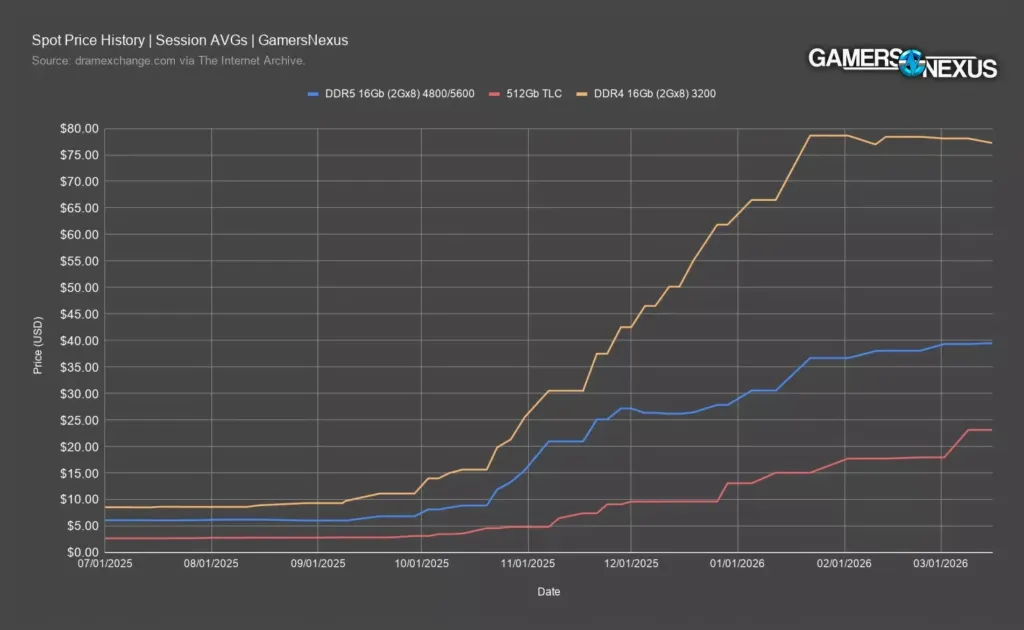
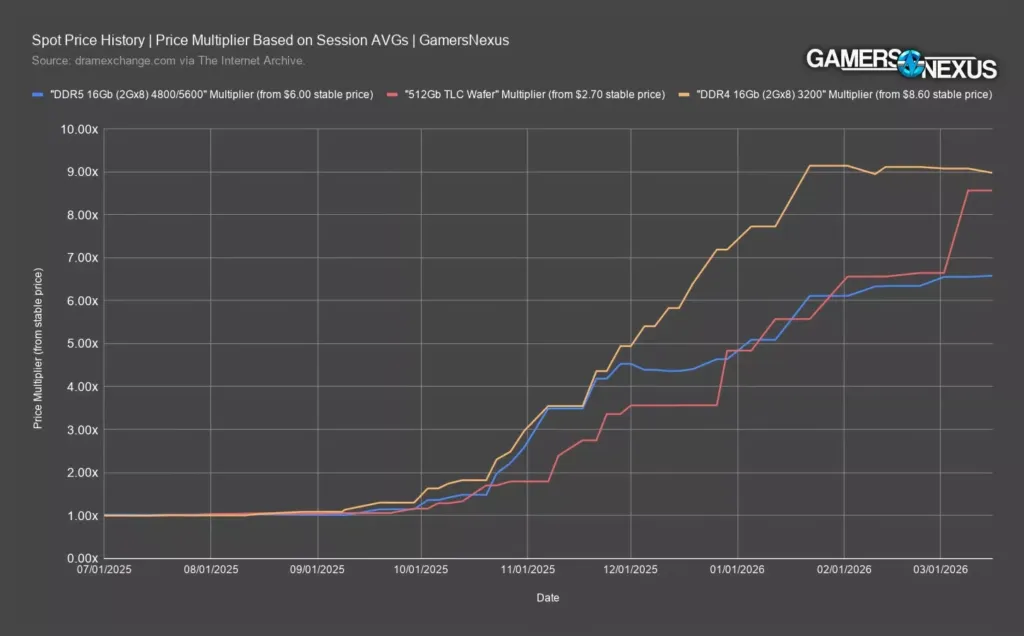
DDR4 is the stranger story of the two. Through October and November its multiplier tracked DDR5’s almost line for line, then it broke away and kept climbing to around 9x while DDR5 was still working its way toward 6x and 7x. GamersNexus traces that split to end-of-life announcements, which squeezed supply right as buyers started stockpiling the parts they figured wouldn’t be made much longer. DDR4 16Gb has held near $80 since mid-January rather than keep running, which at least means the chip that scared everyone most has stopped getting scarier.
What a Retail Kit Actually Costs Now
Spot chip prices are an abstraction until they show up on a kit box. A 32GB DDR5-6000 CL30 kit, the bread-and-butter choice for anyone building a gaming rig, sold for under $90 in early 2025 and was fetching around $529 by late 2025 into 2026. A 32GB DDR4 kit went from $60 to $90 in October 2025 to $150 to $180 by January 2026, roughly doubling in three months while its cousin sat at nearly quadruple its starting price. GamersNexus’s read on common kits across the board is a multiplier upwards of 5x, which puts the DDR5 kit’s roughly fourfold jump on the low end of what’s actually happening out there.
| Kit | Before | Now |
|---|---|---|
| 32GB DDR5-6000 CL30 | under $90 (early 2025) | ~$529 |
| 32GB DDR4 | $60–$90 (Oct 2025) | $150–$180 (Jan 2026) |
The index numbers are one thing. Here’s what it looks like from the receipt of one builder who bought the same kit twice.
2 Sticks of 16 GGB DDR5 ram cost me $120 in May of 2025, same ram cost $599 now.
Contract Prices and the Fight Over What Comes Next
Team Group’s general manager told Tom’s Hardware that DRAM and NAND both doubled in price inside a single month, and that the pricing crisis had only just started, with 2026 set to be worse than 2025. Team Group makes memory. It profits every time that number goes up, which makes a warning this blunt from this particular source worth more than the same line from an analyst with nothing riding on the answer.
On the contract side, where OEMs and retailers actually negotiate, TrendForce had conventional DRAM up 50% to 55% quarter-over-quarter early in 2026, then accelerating to as much as 89% by the second quarter, a figure Wccftech picked up from the same data. Counterpoint Research, working independently, describes per-quarter increases in the same 80% to 90% range. Gartner’s number for the broader memory cost surge runs even higher, on the order of 130%. Three different research houses, three different methodologies, and all three point the same direction at roughly the same altitude.
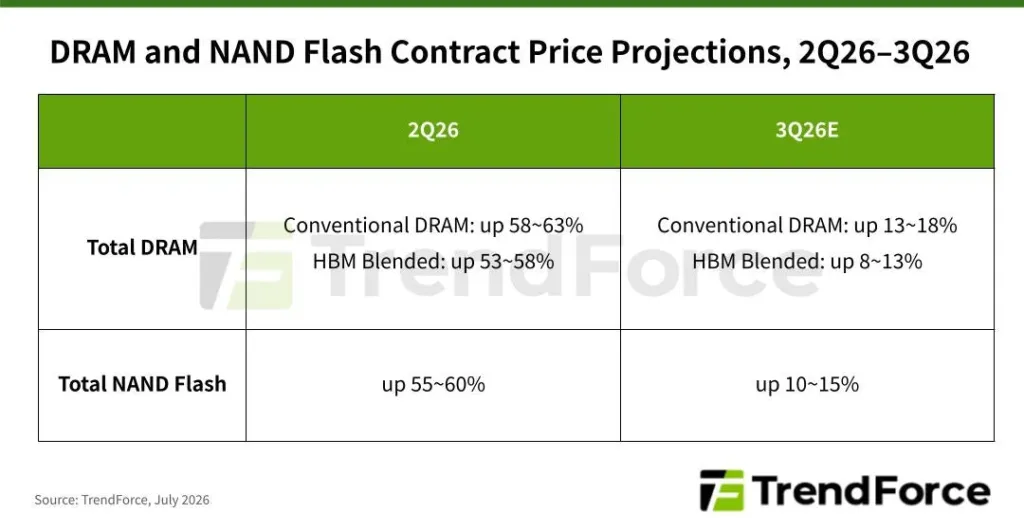
Here’s the widest gap in this whole story. For the same July-to-September quarter, TrendForce has conventional DRAM contracts rising 13% to 18% and NAND Flash up 10% to 15%, while Jefferies has memory prices overall up 40% to 50% — roughly three times TrendForce’s number, for the same three months. Jefferies isn’t done either: it stacks another 30% to 40% onto Q4 2026 and projects 40% to 45% year-on-year growth across 2027. TrendForce’s read is that the slowdown it’s forecasting reflects high prices finally choking off consumer demand. Both are credible research houses looking at the same quarter and landing a long way apart, and nobody outside either building knows for certain which number is closer to what actually happens.
| Forecast | Q3 2026 quarter-over-quarter |
|---|---|
| TrendForce, conventional DRAM contract | +13% to 18% |
| TrendForce, NAND Flash contract | +10% to 15% |
| Jefferies, memory prices | +40% to 50% |
When does this end?
However far apart the quarterly numbers run, the endpoints line up. Jefferies doesn’t expect substantial price deceleration before 2028 at the earliest. Intel points to the same year before conditions normalize. Silicon Motion warns the shortage spans HDDs, DRAM, HBM and NAND clear into 2028. Gartner’s the outlier on timing, calling an end to the storage crunch by 2027. Nobody here is arguing this stops soon, the argument is only over how brutal the next two quarters get on the way there.

Lexar’s Switch to CXMT Chips
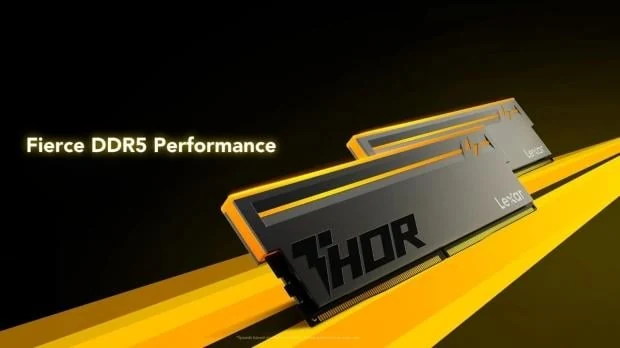
Lexar is building its THOR II DDR5 kits, a 32GB dual-channel set made of two 16GB modules, with DRAM from ChangXin Memory Technologies instead of Samsung, SK hynix or Micron. IT Home reported it first, TechPowerUp picked it up, and the kits still carry Intel XMP and AMD EXPO profiles like any other THOR module. A year ago a Chinese chip in a gaming RAM kit sold under a recognizable brand name would have been a novelty act. Now it’s just what’s available.
| Kit | Lexar THOR II DDR5 |
| DRAM supplier | CXMT (ChangXin Memory Technologies) |
| Capacity | 32GB dual-channel (2 x 16GB) |
| Rated speeds | 7,200 and 7,600 MT/s |
| Timings | CL38 |
| Voltage | 1.4V |
| Previous CXMT ceiling | DDR5-6000 (6,000 MT/s) |
| Overclocking profiles | Intel XMP and AMD EXPO |
That 7,200 to 7,600 MT/s rating, at CL38 and 1.4V, isn’t an incremental bump for CXMT, it’s a jump past a wall the company hadn’t cleared before. CXMT’s previous ceiling sat at DDR5-6000, more than a thousand megatransfers a second lower. Samsung, SK hynix and Micron have been pulling resources toward AI data centre memory, and that’s left a gap at the enthusiast tier that a fourth supplier now has room to fill.
Chinese NAND Isn’t Cheap Either
The fanxiang S880, a 2TB drive built on YMTC NAND with a host memory buffer in place of a dedicated DRAM cache, went from $135 to $300 since November, a 122.2% increase that GamersNexus tracked alongside everything else. It was the cheapest drive on the November list. Chinese NAND didn’t dodge the surge that hit Samsung and WD, it rode it up just as hard.
| 2 TB NVMe SSD | Price (11/12) | Price (03/12) | Price Increase (%) |
|---|---|---|---|
| fanxiang S880 NVMe SSD 2TB [HMB] | $135.00 | $300.00 | 122.2% |
| Crucial P310 2 TB M.2-2280 PCIe 4.0 X4 NVME SSD [HMB] | $145.00 | $300.00 | 106.9% |
| WD_Black SN850X 2 TB M.2-2280 PCIe 4.0 X4 NVME SSD [DRAM] | $190.00 | $350.00 | 84.2% |
| Kingston NV3 2 TB M.2-2280 PCIe 4.0 X4 NVME SSD [HMB] | $150.00 | $380.00 | 153.3% |
| Samsung 990 Pro 2 TB M.2-2280 PCIe 4.0 X4 NVME SSD [DRAM] | $190.00 | $400.00 | 110.5% |
| Averages | $162.00 | $346.00 | 115.4% |
The fanxiang still sits $80 to $100 below the two priciest 2TB drives on the list and is tied for the cheapest current price, so it remains the drive to buy if price is the whole decision. But GamersNexus points out that YMTC and fanxiang are capitalizing on the shortage just like everyone else, not undercutting it. Cheaper, yes. Insulated from the same squeeze, no.
Here’s the loop that makes this worse instead of better: Omdia data reported by ChosunBiz shows Samsung cut NAND wafer output from 4.9 million to 4.68 million, and SK hynix cut its own from about 1.9 million to 1.7 million, partly in response to rising cheap Chinese NAND supply. Neither company cut evenly. They pulled volume out of mobile and PC NAND to defend profitability there and pushed more capacity toward server and enterprise instead. So the arrival of a cheaper Chinese competitor hasn’t loosened supply for anyone building a PC, it’s tightened it, because the incumbents answered by shrinking the exact segment that competitor was entering.
Kye-hyun Kyung, who used to run Samsung’s chip group, thinks memory prices could drop within a year, as Chinese DRAM volume keeps growing. Wccftech framed it as Chinese supply crushing a 414% DDR5 spike. It’s worth hearing from someone who ran that side of the business at Samsung, but nothing in the retail figures above shows that turn happening yet.
Plenty of buyers are hoping the same thing, just from the other side of the checkout.
China is creating their own memory chips now. Hopefully it will start distributing around the world soon so price can go down.
YMTC’s PCIe 5.0 Drive
YMTC has released its first PCIe 5.0 NVMe drive, built on its own in-house Xtacking 4.0 architecture. Xtacking bonds two wafers together per chip to get greater density, which is a fine trade when wafers are cheap and a strange one to lean on when wafer capacity is the scarcest thing in the entire market right now.
What a Build or a Prebuilt Costs Now
The first number anyone building a PC actually sees is the price on a drive at checkout, and GamersNexus’s four-drive average for a 2TB NVMe SSD went from $168.75 to $357.50 in four months, a 113.7% increase. The Samsung 990 Pro 2TB, one of the four drives in that basket, sits at $400 per GamersNexus and $388 per OSCOO. Those aren’t a disagreement about the drive so much as two trackers checking the same part a few weeks apart and finding it’s already moved again.
| 2 TB NVMe SSD | Price (11/12) | Price (03/12) | Price Increase (%) |
|---|---|---|---|
| Crucial P310 2 TB M.2-2280 PCIe 4.0 X4 NVME SSD | $145.00 | $300.00 | 106.9% |
| WD_Black SN850X 2 TB M.2-2280 PCIe 4.0 X4 NVME SSD | $190.00 | $350.00 | 84.2% |
| Kingston NV3 2 TB M.2-2280 PCIe 4.0 X4 NVME SSD | $150.00 | $380.00 | 153.3% |
| Samsung 990 Pro 2 TB M.2-2280 PCIe 4.0 X4 NVME SSD | $190.00 | $400.00 | 110.5% |
| Averages | $168.75 | $357.50 | 113.7% |
None of that is a temporary spike waiting to correct. IDC puts 2026 NAND bit supply growth at 17% year on year and DRAM at 16%, and AI buyers can soak up that entire increment on their own before a single gaming SSD or memory kit gets built. The retail prices above aren’t an overshoot correcting itself; they’re what’s left over once the bigger buyer takes its share first.
Memory’s Share of a PC’s Bill of Materials
HP’s Q1 2026 earnings call gives the cleanest read on how this lands inside a finished PC: memory now makes up 35% of HP’s build materials, up from 15 to 18% just one quarter earlier, because memory costs doubled in that single quarter. HP is already warning of a double digit percentage decline in earnings next quarter. That jump from under a fifth to over a third of a system’s bill of materials, in one quarter, is the mechanism behind every OEM price increase below.
- Lenovo, Dell, HP, Acer and ASUS have all confirmed price hikes of 15 to 20%, and all five have warned clients that conditions get tougher into H2 2026
- Dell’s increases started in mid-December 2025: $130 to $230 added to 32GB configurations, up to $765 added to 128GB workstations
- IDC’s moderate scenario has PC average selling prices up 4-6% overall; its pessimistic scenario puts that at 6-8%
- None of this is a warning about what might happen. Dell’s dollar figures are already on invoices
Higher prices mean fewer PCs sold, and the forecasters largely agree on how much fewer. Gartner and IDC both see the 2026 market down 10-11%, Counterpoint warns it could contract more than 11%, and Omdia has revised its own number to a 12% decline, split between notebooks down 12.5% and desktops down 10.4%. In Omdia’s units that’s 278.9 million PCs in 2025 falling to 245.3 million. IDC’s own downside scenarios sit lower than its headline number, at 4.9% in the moderate case and 8.9% in the pessimistic one, which tells you these are a range of houses working from different assumptions rather than one number everyone’s converged on.
The cheap end of the market takes this worst, because budget PCs lean on legacy memory and lower-density components, and those are exactly the lines facing the tightest supply and the least margin to absorb a price increase. Omdia has education PCs dropping 15% in 2026 on that basis, the steepest decline in its forecast. Gartner carries the same logic two years out and concludes that entry laptops under $500 simply stop being a viable product to build at all.
Every one of those percentages is abstract until somebody adds up a build they were saving for. A 32GB DDR5-6000 CL30 kit that cost under $90 now runs around $529, and that one line item is enough on its own to turn a budget upside down.
I had finally saved up close to $3,500 for a 5090 PC after years of small upgrades then it shot up to around $6k. Crazy stuff.
Is Waiting Worth Anything
- Buy the RAM and primary drive you actually need now, not what you might need
- Skip speculative headroom you won’t touch for years; paying today’s prices for capacity you don’t need yet is a bad bet twice over
- If you need two drives, buy the primary one now and delay the secondary
- Buy a graphics card because you need it, not to wait out a price cut that isn’t coming
- 16GB is now the practical floor on prebuilts, so don’t plan below it
- OSCOO finds 1-2TB is still the most competitive SSD capacity band; 4TB and 8TB have seen the steepest per-gigabyte spikes, so stretching to those sizes costs disproportionately more
Waiting for relief means picking a year, because the people actually making this stuff don’t agree on when it comes. Gartner and Micron CEO Sanjay Mehrotra both point to 2027. Intel, Silicon Motion, and Samsung’s Jaejune Kim all push that out to 2028. SK Hynix’s Kwak Noh-Jung and Kearney’s PERLab analysis both go further still, to 2030. That three-year spread between the earliest and latest estimate, coming from the manufacturers and analysts closest to the supply itself, is the real answer to anyone hoping to time this market: nobody who’d know is willing to promise a date.
Why This Doesn’t Unwind Fast
New memory fabs take years and billions of dollars to build, not quarters. Micron broke ground on a $9.3 billion fab in July 2026, and that plant isn’t expected to produce a single chip until Q3 2028. Even once it does, every maker gives its HBM lines first call on whatever new capacity comes online, ahead of the ordinary DRAM and NAND that goes into a gaming PC. Building more chips was never going to be the quick fix.