
Key Takeaways
- 1At 1080p the RX 9050 8GB averages 49 fps across ten games. That’s slower than the RTX 5050 at 59 fps and the older RX 7600 at 60 fps.
- 2Don’t buy this for 1440p. It averages 33 fps there, and nine of the ten games in the test land under 60.
- 3The RX 9060 XT 8GB is the better buy even at its roughly $400 street price. It averages 86 fps at 1080p and 53 fps at 1440p, and works out around 20% better value per frame.
- 4Intel’s Arc B580 is the best new-card alternative near this price. It’s about $310, 27% faster than the RX 9050, and brings 12GB of memory.
- 5Skip 8GB if you can stretch. In Stalker 2 at 1440p Epic the RX 9050 8GB drops to 8 fps, while the RX 9060 XT 16GB holds 42 fps.
- 6Efficiency is real but doesn’t rescue it. The card draws 92W and the test system pulled about 80W less than one with an Arc B580 or RTX 4060 Ti.
- 7It isn’t a slot-powered card. At 92W against the slot’s 75W it needs a single 8-pin connector, and AMD says 450W minimum.
- 8Check the box before trusting the spec. Sapphire’s PULSE asks for a 650W supply and rates board power at 100W.
- 9Two cards carry the RX 9050 name. The 4GB OEM version has a 64-bit bus and 144 GB/s, and one test had the 8GB card about 37% ahead of it.
- 10Treat $279 as unconfirmed. TechSpot tracks $300, and a German listing for the ASRock Challenger 8GB is €635.59.
Navi 44 With Half the Die Switched On
The RX 9050 is a salvage part. It’s the same 199 mm2 Navi 44 die as the RX 9060 XT, built on TSMC N4P (4nm) with 29.7 billion transistors, but AMD is using dies that couldn’t get 2048 working cores, and couldn’t get the 1792 the RX 9060 needs either. Only 16 of the 32 compute units are enabled, which leaves 1024 stream processors. So this isn’t a small chip built to be cheap. It’s a full-size chip with half of it dark, and every number below follows from that.
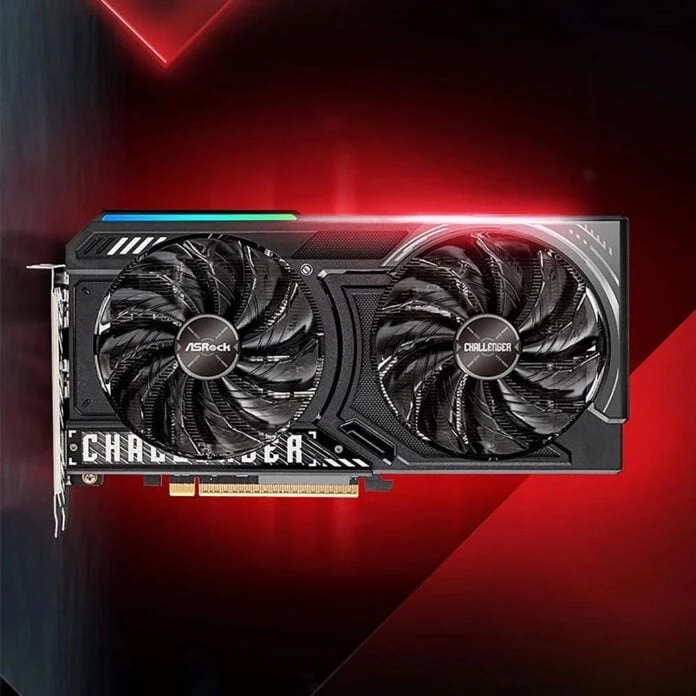
| Architecture | RDNA 4 (Navi 44) |
| Process | TSMC N4P (4nm) |
| Die Size | 199 mm2 |
| Transistors | 29.7 B |
| Compute Units | 16 (of 32 on full Navi 44 die) |
| Stream Processors | 1024 |
| Ray Accelerators | 16 |
| AI Accelerators | 32 |
| ROPs | 64 |
| Texture Units | 64 |
| Game Clock | 1920 MHz |
| Boost Clock | Up to 2600 MHz |
| Peak Single Precision (FP32 Vector) Performance | 10.6 TFLOPs |
| Peak 8-bit Precision (INT8 Matrix) Performance | 85 TOPs |
| Memory | 8 GB GDDR6 |
| Memory Speed | Up to 18 Gbps |
| Memory Interface | 128-bit |
| Memory Bandwidth | Up to 288 GB/s |
| AMD Infinity Cache Technology | 32 MB |
| Typical Board Power (Desktop) | 92W |
| Additional Power Connector | 1×8-Pin |
| Minimum PSU Recommendation | 450W |
| Bus Type | PCIe 5.0 x16 |
| DisplayPort | 2.1a |
| HDMI | 2.1b |
Clocks make the gap wider. The game clock is 1920 MHz and the boost tops out at 2600 MHz, both under what the other two cards run, so the RX 9050 loses on core count and on speed at once. That’s how 16 CUs end up at 10.6 TFLOPs of FP32. The memory side is the part AMD left alone: 8GB of GDDR6 at 18 Gbps on a 128-bit bus gives 288 GB/s, the same as the RX 9060, with the full 32MB of Infinity Cache behind it. A card with half the shader hardware feeding off a memory system sized for more is unlikely to be starved for bandwidth. The 8GB capacity is a separate question, and the game results later will settle it. Ray accelerators (16) follow the CU count, so ray tracing hardware is halved along with the shaders. The 32 AI accelerators are good for 85 TOPs of INT8 matrix work, and the card carries 64 ROPs and 64 texture units.
Typical board power is 92W, against 132W for the RX 9060 and 150W for the RX 9060 XT. That’s 40W under the RX 9060, and the saving comes from the dark half of the die. It still isn’t a slot-powered card: it needs a single 8-pin PCIe connector, and AMD recommends a 450W power supply at minimum. Anyone dropping it into an old prebuilt has to check for that 8-pin lead before anything else. The interface is PCIe 5.0 x16.
| Specification | Radeon RX 9050 8GB | Radeon RX 9060 | Radeon RX 9060 XT 8GB |
|---|---|---|---|
| Compute Units | 16 | 28 | 32 |
| Stream Processors | 1,024 | 1,792 | 2,048 |
| Game Clock | 1,920 MHz | 2,400 MHz | 2,530 MHz |
| Boost Clock | Up to 2,600 MHz | Up to 2,990 MHz | Up to 3,130 MHz |
| Memory | 8GB GDDR6 | 8GB GDDR6 | 8GB GDDR6 |
| Memory Bus | 128-bit | 128-bit | 128-bit |
| Memory Bandwidth | 288 GB/s | 288 GB/s | 320 GB/s |
| Infinity Cache | 32 MB | 32 MB | 32 MB |
| Typical Board Power | 92W | 132W | 150W |
The May leak got the card wrong by half. It listed 32 compute units and 2048 stream processors, which would have made the RX 9050 a full RX 9060 XT core count running slower. ASRock’s July listing put the real figures at 16 compute units and 1024 shaders. The leak did get the clocks right, 1920 MHz game and 2600 MHz boost, and that’s what made it convincing: if the clocks are right, the core count looks like the same source’s work. Anyone who priced this card in their head off the May numbers was pricing a much faster GPU than AMD shipped.
Port Counts Don’t Match Across Sources
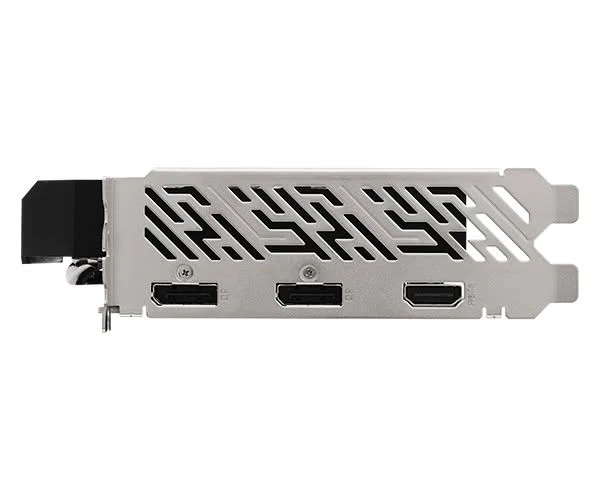
Tom’s Hardware describes two DisplayPort 2.1a and one HDMI 2.1b on ASRock’s card. SAPPHIRE’s PULSE page and Tech Times both list two HDMI 2.1b and one DisplayPort 2.1a. The port versions aren’t in dispute, only how many of each. SAPPHIRE says the PULSE drives a maximum of three displays. If you need a specific mix of outputs, check the exact board before buying.
The one thing the cuts didn’t touch is the feature set. The 32 AI accelerators handle FP8 matrix operations natively, and that’s why FSR Redstone runs on the RX 9050. RDNA 3 only handles FP16 and INT8 matrix operations, so AMD backported FSR 4.1 upscaling to those older cards using INT8. Ray Regeneration and Radiance Caching stay RDNA 4 only. That gives the RX 9050 a real software advantage over the older Radeons it will be compared with, even where its frame rates don’t.
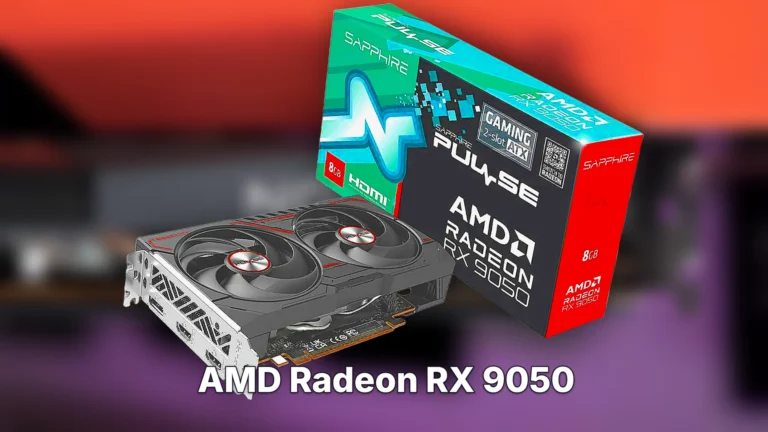
Sapphire PULSE and ASRock Challenger RX 9050 Cards
ASRock, Sapphire and PowerColor all sell retail RX 9050 cards, and the one you end up with won’t necessarily match AMD’s spec page. ASRock’s Challenger 8GB sticks to the reference top clocks, listing 1920 MHz base and 2600 MHz boost. Sapphire’s PULSE pushes the boost to 2760 MHz, with a game clock of up to 2260 MHz. It’s the same silicon under both coolers, but the numbers printed on the boxes aren’t the same.
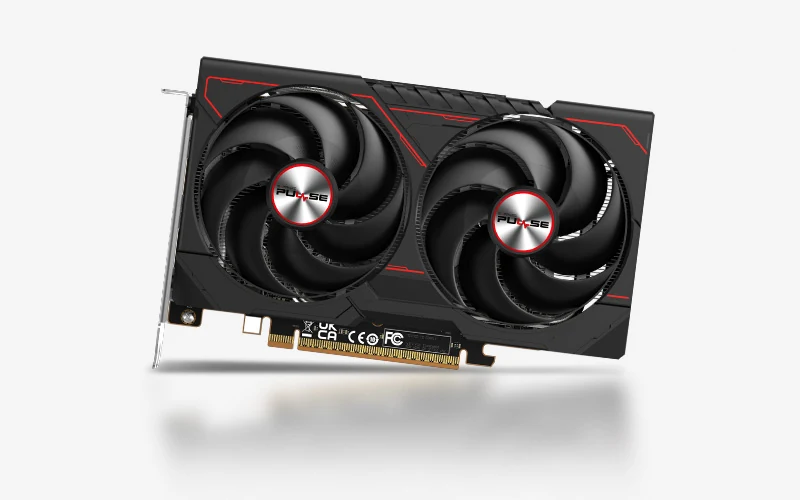
| Boost Clock | Up to 2760 MHz |
| Game Clock | Up to 2260 MHz |
| Stream Processors | 1024 |
| Compute Units | 16 CUs (3rd Gen RT + 2nd Gen AI Accelerators) |
| Infinity Cache | 32MB |
| Ray Accelerators | 16 |
| AI Accelerator | 32 |
| Memory Size/Bus | 8GB/128 bit GDDR6 |
| Memory Clock | 18 Gbps Effective |
| Displays | Maximum 3 Displays |
| Output | 2x HDMI 2.1b, 1x DisplayPort 2.1a |
| Interface | PCI-Express 5.0 x16 |
| Game Index | 1080P Medium/High |
| Power Consumption | 100W Typical Board Power |
| System Requirement | Minimum 650 Watt Power Supply |
| Form Factor | 2 slot, ATX |
| Dimension | 200(L) X 109.25(W) X 40.6(H)mm |
Check the PSU Before You Buy
AMD says 450W is enough for the RX 9050. Sapphire asks for a minimum 650W supply for the PULSE, and rates it at 100W typical board power against AMD’s 92W. If you’re dropping this into an old budget box and shopped off AMD’s spec page, you could end up with a power supply the partner card’s own paperwork says is too small.
| Card | Boost clock | Typical board power | PSU recommendation |
|---|---|---|---|
| AMD reference Radeon RX 9050 | Up to 2600 MHz | 92W | 450W |
| ASRock RX 9050 Challenger 8GB | Up to 2600 MHz | — | 450W |
| Sapphire PULSE RX 9050 8GB | Up to 2760 MHz | 100W | 650W |
| ASUS ROG Strix RX 9050 | — | 130W | — |
Board power climbs the further you get from reference. Russian retailer FPSHQ lists an ASUS ROG Strix RX 9050 at 130W for 39,000 rubles, against the 92W AMD prints for its own card, and Sapphire’s 100W sits in between. Any pitch that calls this one of the most efficient cards shipping is really describing the reference design, not necessarily the one on the shelf.
- Honeywell PTM7950 thermal material sits under the PULSE cooler.
- A 7-phase digital power design feeds the card.
- Sapphire’s own game index says 1080P Medium/High, so the vendor is telling you what the card is for before anyone benchmarks it.
- It drives a maximum of three displays.
- Outputs are two HDMI 2.1b and one DisplayPort 2.1a.
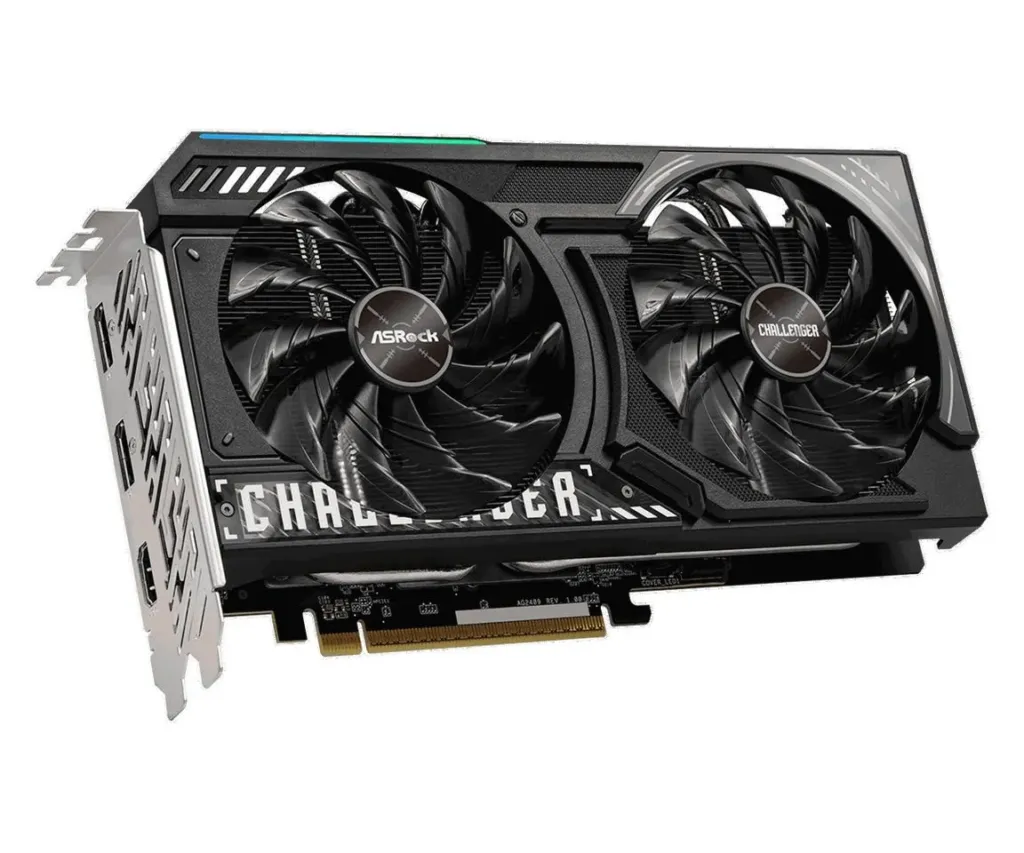
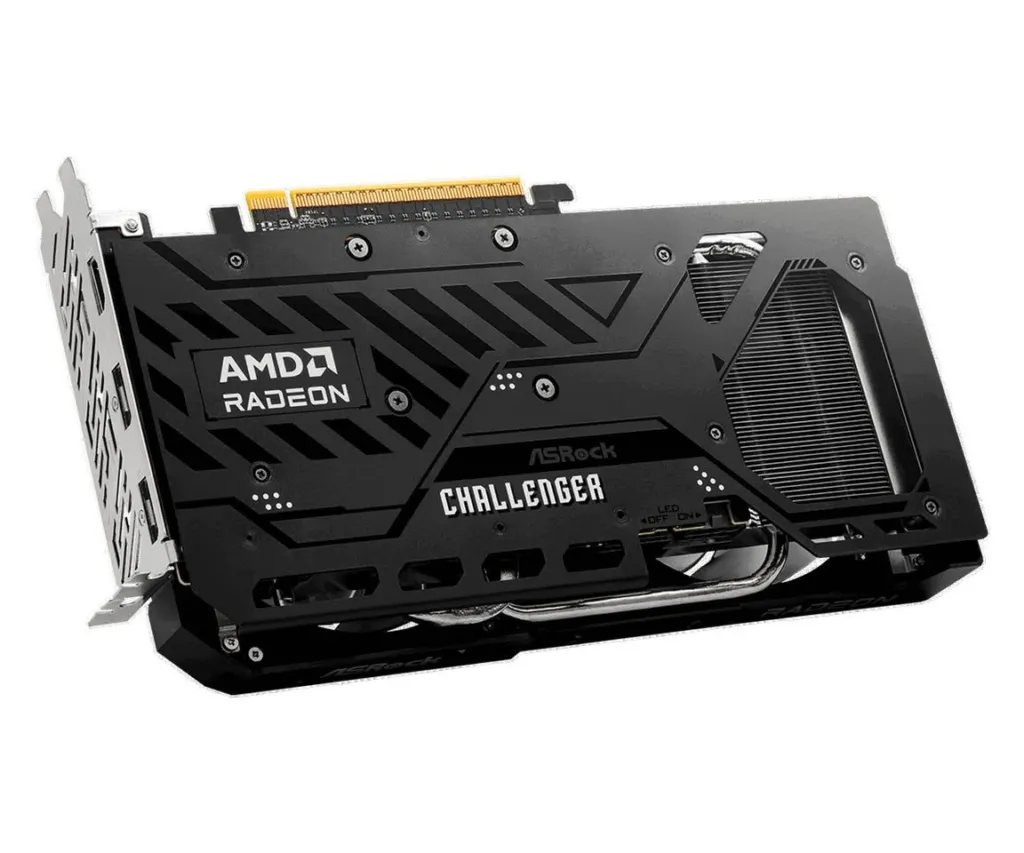
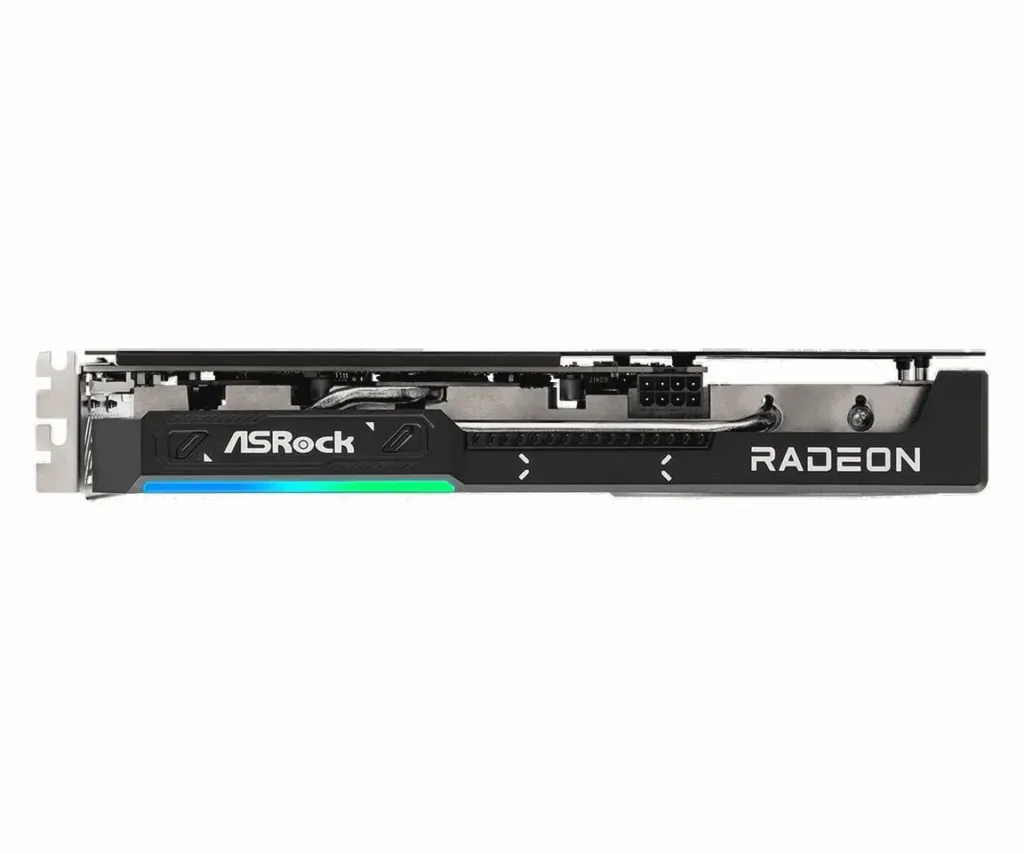
The Challenger is the plain option: reference clocks, 8GB of GDDR6 on a 128-bit bus, 16 compute units, and in the leaked shots a black shroud with silver accents and some RGB. If you want the card AMD described, this is the closest one. Every partner design is dual-slot and dual-fan, and the longest run up to 249mm, so the Sapphire’s 200 mm is on the short end and fit is rarely going to be the problem.
AMD’s Own 1080p Numbers, No Review Cards
AMD did put frame rates on the RX 9050 product page, but at 1080p Medium, where the RX 9060 got 1080p Ultra figures. That one change of settings means nothing AMD has published lets you set the two cards side by side, which is convenient for a card sitting a rung below. Every figure is also for the 8GB card. The 4GB model shares the name and should score lower than anything on the page.
AMD’s own RX 9050 8GB figures, 1080p Medium
The esports end of the chart is where a card this size looks its best: Counter-Strike 2 at 227fps, Rainbow Six Siege at 206fps, and Valorant at 593fps. Valorant is the only title AMD ran at High instead of Medium, so the biggest number on the page was also produced under different rules from the rest. The other end is the one to watch. 007: First Light manages 60fps at Medium, the lowest figure AMD printed and the one that shows how little room is left once a game gets heavy. Club386 called it an obvious red flag, and it’s hard to argue when AMD picked the settings itself.
These Numbers Are for the 8GB Card Only
Every figure above comes from the 8GB card on a 128-bit bus. The 4GB version is 64-bit, carries the same RX 9050 name, and isn’t described by any of AMD’s benchmarks. Club386 says to expect lower results from it.
The Bench AMD Ran Them On
| CPU | Ryzen 7 9800X3D |
| Memory | 32GB DDR5-6000 |
| Motherboard | B650E |
| Driver | 26.6.2 |
| Tested | July 2026 |
AMD deserves credit for putting the platform in the footnotes, but the platform is the problem. Tech Times points out that a Ryzen 7 9800X3D is no realistic pairing for a $279 card, and its 3D V-Cache exists to cut game loop latency, which is exactly what flatters a frame rate in CPU-bound games like the esports titles at the top of the chart. Anybody pairing this card with a mid-range CPU should expect lower results. The footnotes also never say whether FSR was switched on for any title, so it’s impossible to tell if those figures are native rendering or upscaled ones. Until an independent bench says otherwise, treat them as a ceiling.
The RX 9060 slides look nothing like this. PC Guide reports AMD ran that card at 1080p Ultra with ray tracing, and got 153 FPS in DOOM Eternal and 100 FPS in Resident Evil 4 Remake. Those are different games, at heavier settings, so the two sets of numbers can’t be read against each other.
AMD’s RX 9060 slide figures, 1080p Ultra with ray tracing
No Review Program, No Sample Cards
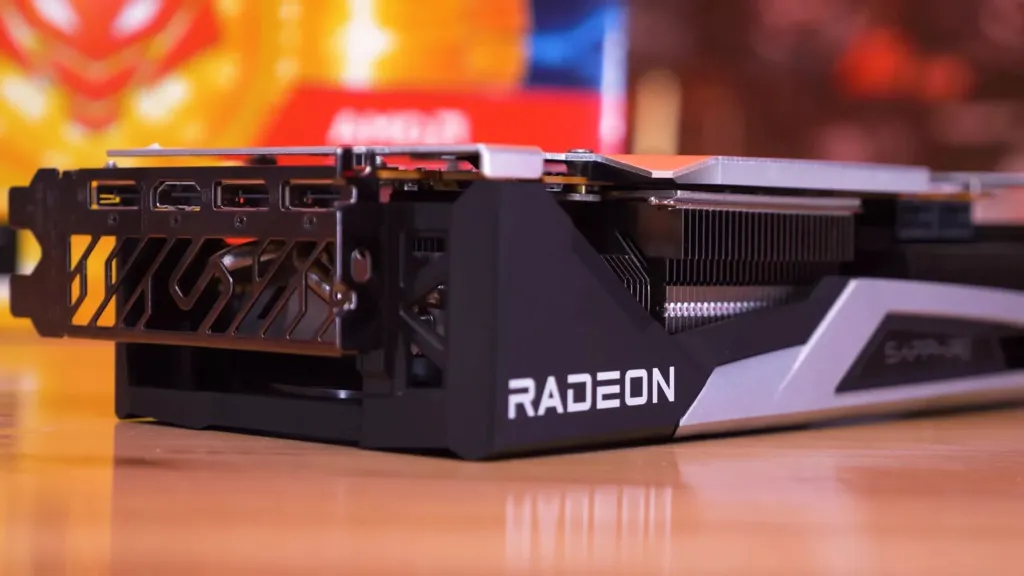
Nobody got a card the normal way. Club386 confirmed it was never offered one, and TechSpot was refused a sample by AMD, with no board partner permitted to send it a card either. TechSpot got its card through side-channel contacts and still can’t name which RX 9050 model it tested, which is why its review illustrates the piece with a different Radeon. When a vendor publishes its own numbers and leaves the checking to people who had to go around it, that tells you how much AMD wanted them checked.

Ten Games at 1080p, 33 to 104 fps
Nothing in the test rig is holding this card back, and that matters more than usual for a budget part. TechSpot paired it with a Ryzen 7 9800X3D, an MSI MPG X870E Carbon WiFi and G.Skill Trident Z5 RGB DDR5-6000 CL30, with Resizable BAR switched on in the BIOS, running Windows 11 25H2 and Adrenalin 26.7.1 WHQL. That’s about the fastest gaming CPU setup you can put behind a $279 card, so the CPU is out of the picture. Every frame rate below is the graphics card’s own, and anyone pairing it with a cheaper processor should expect the same or worse.
| CPU | AMD Ryzen 7 9800X3D |
| Motherboard | MSI MPG X870E Carbon WiFi [BIOS 7E49v1A4] Resizable BAR Enabled |
| Memory | G.Skill Trident Z5 RGB DDR5-6000 CL30 [CL30-38-38-96] |
| ATX Case | MSI Prospect 700R |
| Power Supply | Kolink Regulator Gold ATX 3.0 1200W |
| Storage | TeamGroup T-Force Cardea A440 M.2 PCIe Gen4 NVMe SSD 4TB |
| Operating System | Windows 11 25H2 |
| Display Driver | AMD Radeon Adrenalin 26.7.1 WHQL / GeForce Game Ready Driver 610.88 |
The card wasn’t running slow either. TechSpot measured a 2,770 MHz average core clock under load, holding between 2.7 and 2.8 GHz, which is above AMD’s 2600 MHz reference boost figure the whole way through. Power sat around 90W with a 92W peak, so it was being fed properly too. Whatever disappoints in the chart below, the silicon was given every chance and this is what it does.
Radeon RX 9050 8GB at 1080p, TechSpot
Four of the ten games never got near 60 fps: Marvel Rivals at Ultra managed 41 fps, Clair Obscur: Expedition 33 at Epic 36 fps, Starfield at Ultra 34 fps and Stalker 2 at Epic 33 fps. Those are the top presets, so the fix is turning settings down, and a buyer will be doing that on day one with current releases rather than in year three. Marvel Rivals is the one that stings, because a competitive shooter at 41 fps is a game you play worse than you should.
The middle of the chart camps just under the 60 fps line. Jedi: Survivor gets 57 fps, Hogwarts Legacy at High 56 fps and A Plague Tale: Requiem at Ultra 53 fps, and only Cyberpunk 2077: Phantom Liberty clears 60, with 67 fps at the dialled-back High preset. These are playable and nothing more, and since they’re averages, the dips underneath will be lower still.
Marvel’s Spider-Man Remastered at Very High is the only comfortable result, and the only one over 100 fps, at 104 fps. It’s also an older, lighter game, which is why it stands apart: the one title that runs well is the one that doesn’t resemble what people are buying this year.
In Warhammer 40,000: Space Marine 2 at Ultra the RX 9050 lands dead level with Intel’s Arc B580 at 56 fps, so a rival budget card produces exactly the same figure in that game, and that’s the yardstick $279 gets measured against.
Ten Games at 1440p, Nine Below 60 fps
Nine of the ten games land under 60 fps once TechSpot bumps the resolution, and most of them land far under. Clair Obscur: Expedition 33 averages 22 fps and Starfield at 1440p Ultra manages 26, which is slideshow territory in a single-player game. Marvel Rivals, a competitive shooter where frame rate is the whole point, drops to 27 fps. Star Wars Jedi: Survivor gets 35 fps and Cyberpunk 2077: Phantom Liberty, the best of this group, reaches 44 fps. Native 1440p is out of reach for this card in modern games at the settings TechSpot used, and nobody should buy it planning otherwise.
Radeon RX 9050 8GB at 1440p, ten games
Marvel’s Spider-Man Remastered is the lone survivor, holding 65 fps and the only game in the set to clear 60. Hogwarts Legacy at 1440p High averages 43 fps and Space Marine 2 at 1440p Ultra manages 39, so the two sit in the low forties and high thirties. One older, well-optimised game clearing the bar doesn’t make this a 1440p card. It makes it a card with one good 1440p result.
Upscaling Isn’t Optional Here
Marvel Rivals fell to 27 fps at 1440p on the RX 9050, and TechSpot said upscaling becomes mandatory at that frame rate. Treat it as the only route to a usable 1440p frame rate on this card, not a nice extra.
A Plague Tale: Requiem at 1440p Ultra averages 32 fps on the RX 9050, and that’s behind the much older RX 6600 on average frame rate. The new card’s one win is in the 1% lows, where it edges the RX 6600 by two frames, 28 fps against 26 fps. A slightly steadier floor is thin consolation when neither card is anywhere near playable at these settings.
Stalker 2 Hits the 8GB Wall
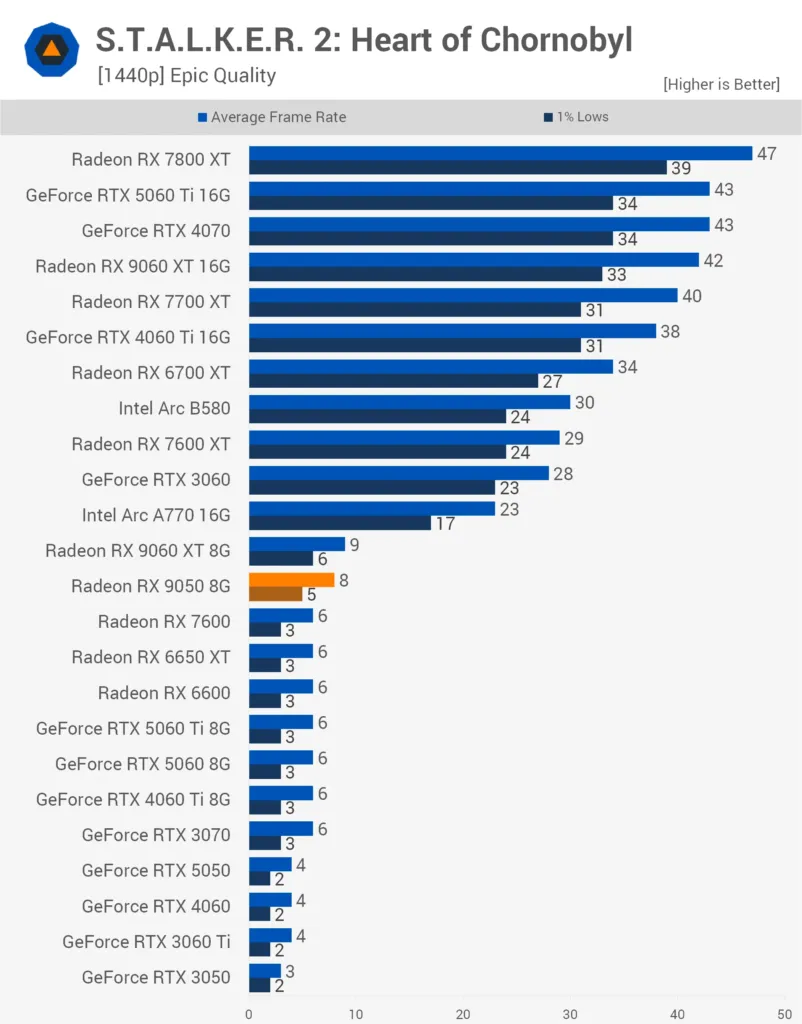
This is a memory failure, not a shader failure. At 1440p Epic the RX 9050 8GB drops to 8 fps in Stalker 2, and it isn’t alone: the RTX 3050, RX 6600, RTX 5050 and RX 7600 all collapsed too, so nearly every card with 8GB or less fell off the same cliff. AMD’s faster RX 9060 XT 8GB only reaches 9 fps, and the gap between 8 and 9 fps means nothing when neither is a game you can play. The same RX 9060 XT with 16GB still manages 42 fps, so capacity decides this result, not shader speed.
Stalker 2: Heart of Chornobyl at 1440p Epic
RX 9050 8GB Ten-Game Averages at 1080p and 1440p
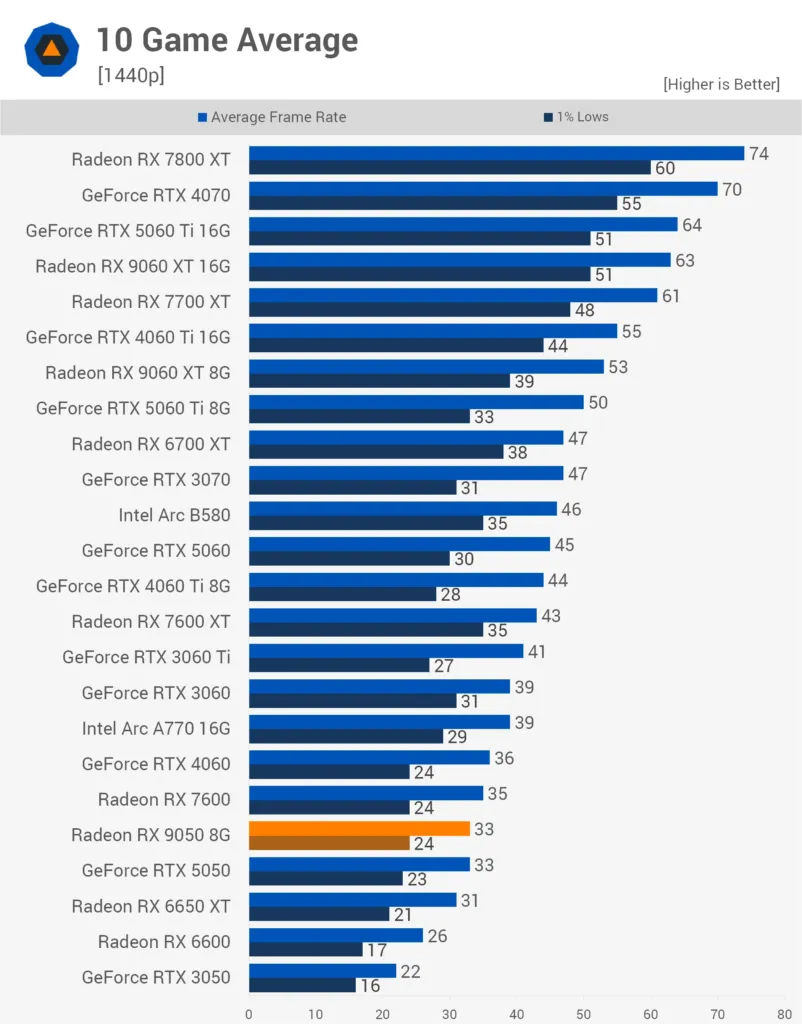
Forty-nine fps is where the RX 9050 8GB lands across TechSpot’s ten games at 1080p, and 33 fps is where it lands at 1440p. A card that’s just launched, at 49 fps, sits near the bottom of the current 1080p field, so it doesn’t really compete with the cards people are buying now. It’s fighting for the last spot on the chart, and the 1440p figure says that resolution isn’t part of its job.
Radeon RX 9050 8GB ten-game average
The only cards the RX 9050 8GB clearly beats are the oldest ones in the stack, and one of them barely counts. At 1080p it’s 23% ahead of the RTX 3050 but only 11% ahead of the RX 6600, an older Radeon that a buyer can still pick up for less. Both margins grow at 1440p, to 50% over the RTX 3050 and 27% over the RX 6600, but everything in that comparison is running slow enough by then that a bigger percentage is a bigger lead over a frame rate nobody wants. The 1080p gap is the one that matters, and 11% is a thin return for a new generation.
| Ten-game average | 1080p | 1440p |
|---|---|---|
| Radeon RX 9050 8GB | 49 fps | 33 fps |
| Lead over GeForce RTX 3050 | 23% | 50% |
| Lead over Radeon RX 6600 | 11% | 27% |
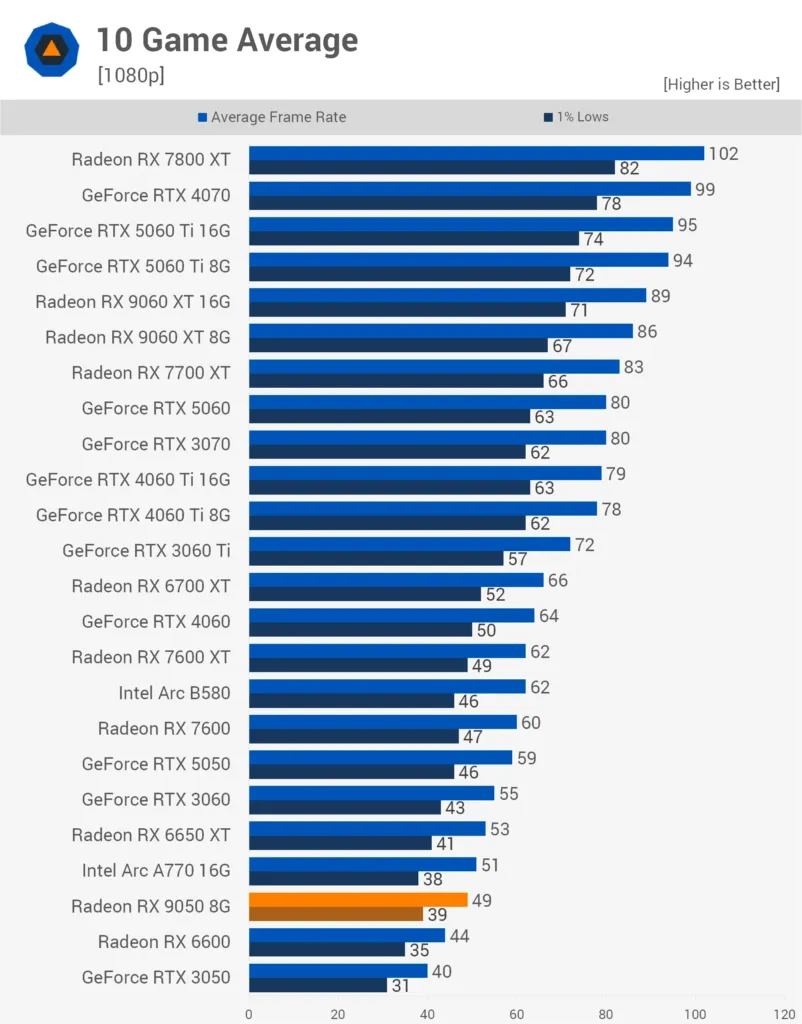
Thirty-three fps doesn’t make native 1440p a stretch at these quality settings so much as a non-starter. Anyone who wants to run AAA games at that resolution on this card will be switching upscaling on because there’s no other way to get a playable frame rate, not because they prefer the look. Lowering settings is the other route, and at that point a 1440p monitor is doing very little for you.
RX 9050 8GB vs GeForce RTX 5050
The RTX 5050 averaged 59 fps across TechSpot’s ten 1080p games, which puts Nvidia’s cheapest current card 20% ahead of the RX 9050. Parity was the optimistic call going in. The RX 9060 had already beaten the RTX 5050 by 19.8% in Korean testing, and the 9050 is that card with half its compute switched off, so a tie was the best anyone could reasonably hope for. At 1080p it didn’t get there.
RX 9050 8GB vs RTX 5050, ten-game averages
Both cards average 33 fps at 1440p, and it would be a mistake to read that as the Radeon catching up. The 9050 drops from 49 fps at 1080p to that figure, and the RTX 5050 falls further to meet it. Native 1440p is a tall order for this Radeon, and the Nvidia card doesn’t cope any better. The tie is two cards running out of road at the same spot, and nobody should buy either one to play at that resolution.
| Game (1080p) | RX 9050 8GB | RTX 5050 |
|---|---|---|
| Clair Obscur: Expedition 33 (Epic) | 36 fps | 39 fps |
| Marvel Rivals (Ultra) | 41 fps | 50 fps |
| Star Wars Jedi: Survivor | 57 fps | 70 fps |
| A Plague Tale: Requiem (Ultra) | 53 fps | 61 fps |
| Cyberpunk 2077: Phantom Liberty (High) | 67 fps | 72 fps |
| Marvel’s Spider-Man Remastered (Very High) | 104 fps | 124 fps |
| Hogwarts Legacy (High) | 56 fps | 70 fps |
| Starfield (Ultra) | 34 fps | 41 fps |
| Stalker 2: Heart of Chornobyl (Epic) | 33 fps | 33 fps |
| Warhammer 40,000: Space Marine 2 (Ultra) | 56 fps | 77 fps |
The lead is widest in Space Marine 2, where the RTX 5050 takes 77 fps against 56 for a 38% margin. Marvel Rivals goes to Nvidia by 22% at 50 fps, Starfield by 21% at 41 fps, Spider-Man by 19% at 124 fps, and Jedi Survivor comes out at 70 fps against the Radeon’s 57. The 9050 gets closest in Clair Obscur, 8% back at 39 fps for the Nvidia card, and it ties Stalker 2 outright at 33 fps. Neither of those is a win worth having, because both cards sit at or below 39 fps in those games and nobody plays them comfortably on either.
The one game the Radeon wins
In Clair Obscur at 1440p the RX 9050 manages 22 fps to the RTX 5050’s 16, a 38% lead that turns the 8% deficit it had at 1080p into a win. It’s the only clean reversal in the data. At 22 fps the game is unplayable anyway, so this says something about how the two cards fall apart and nothing about which one to buy.
Nvidia’s $249 MSRP for the RTX 5050 isn’t what anyone pays. TechSpot saw it selling at $320, Tech Times quoted roughly $309 on Amazon, and Tech Insider put an August 2026 street price at $438. Those numbers disagree because they were taken at different moments in a rising market, and the spread is the story: the RTX 5050 has been getting more expensive, not less. AMD priced the RX 9050 8GB at $280. Set that against TechSpot’s $320 street figure and the gap is $40, which TechSpot argues isn’t enough to sway anyone when the cheaper card is also the slower one.
| Radeon RX 9050 8GB | GeForce RTX 5050 | |
|---|---|---|
| GPU | Navi 44 | GB207 |
| Cores | 1,024 | 2,560 |
| Memory | 8 GB GDDR6 | 8 GB |
| Memory bus | 128-bit | 128-bit |
| Bandwidth | 288 GB/s | 320 GB/s |
| Board power | 92W | 130W |
| MSRP | $280 | $249 |
Power is the one column the Radeon wins: 92W against the RTX 5050’s 130W, as Tech Insider measured. It’s a real edge, and it’s the only thing the 9050 takes off Nvidia in this matchup. The RTX 5050 is a GB207 chip with 2,560 cores, the RX 9050 has 1,024 stream processors on Navi 44, and both carry 8GB on a 128-bit bus, with the Nvidia card getting 320 GB/s against the Radeon’s 288 GB/s. Nvidia has more of everything except appetite for watts, and it’s also the cheaper card on paper at $249 against $280.
The RTX 5050 isn’t a card anyone is excited about. TechSpot called it e-waste in its own review, since it’s supposed to cost $250 and sells for $320. The RX 9050 comes in slower and worse value than that, and losing to a card the same reviewer had already written off is the clearest measure of where AMD’s new $280 part landed.
The RX 9050 Against AMD’s Older Cards
The previous-generation RX 7600 averaged 60 fps across the ten games at 1080p, which puts it 22% ahead of a card AMD launched after it, and the RX 9050 managed 49. At 1440p the gap shrinks to 6%, with the RX 7600 at 35 fps and the RX 9050 at 33, but that isn’t the new card catching up. Both have fallen so far below a playable frame rate that there’s nothing left to lose.
10-game average, 1080p
The average hides how lopsided individual games get. Starfield at 1080p is the worst of it, with the RX 7600 41% faster, and Hogwarts Legacy is close behind at 36% and 76 fps. Space Marine 2 goes to the older card by 25% at 70 fps, it also takes Jedi Survivor at 72 fps, and it reaches 65 fps in A Plague Tale: Requiem. Those are margins you’d feel in play, and they all run in the wrong direction for a new release.
Radeon RX 7600 at 1080p, where it wins outright
The RX 9050’s only 1080p win over the RX 7600 is Spider-Man Remastered, by 2%, and that’s inside what you’d expect from run-to-run variation. It doesn’t survive a resolution bump either: at 1440p the RX 7600 takes that game back and finishes 15% ahead at 75 fps. Clair Obscur is the other near-tie at 1080p, and it still goes to the older card, 37 fps to 36.
The RX 6600 is an RDNA 2 card, an earlier generation again, and the RX 9050 can’t pull away from it. In Hogwarts Legacy the two are level at both 1080p and 1440p, and in A Plague Tale the new card is ahead by only 6% at 1080p. The bar is low, too: in Starfield the RX 6600 itself only ties the RTX 3050 at 28 fps, so being level with it is no achievement.
People watching the results reached the same verdict the charts did, which is that older, cheaper cards are outpacing the new one.
So it’s basically its the RX6600 type GPUs for the latest series with the latest tech software features, it’s basically a 1080p card for medium settings maybe high some games Just it gets out paced by older cards which is the major issue here
The frame rates are low enough that some viewers took them for an old card being retested, and TechSpot’s warning that the RX 9050 could reach stores at $300 or more makes that confusion sting.
I genuinely forgot this is supposed to be a new $300 card not a 5 year old card. Part way through I was like wow we have come a long way. Then I went, wait… 🤣😭😭
One Rung Up: The RX 9060 XT 8GB
Step up one tier in AMD’s own stack and you’re in a different class of card. The RX 9060 XT 8GB averages 86 fps at 1080p against the RX 9050’s 49, which is 76% faster, and at 1440p it manages 53 fps to the 9050’s 33, a 61% lead. That second pair matters more than the percentage. 33 fps is a card that’s given up at 1440p, and 53 fps is one that’s within reach of 60 with a setting or two turned down. Same die, same memory size, and one of them still has a use for the higher resolution.
RX 9050 8GB vs RX 9060 XT 8GB, ten-game averages
The averages undersell it, because the gap widens in the games that punish a card hardest. A Plague Tale: Requiem at 1440p is the widest margin in the set, with the 9060 XT at 69 fps and a 116% lead, which means the cheaper card is under half the speed. Hogwarts Legacy is close behind, 95% ahead at 1440p with 84 fps and 88% ahead at 1080p with 105. The lightest games in the set are where the lead shrinks: Cyberpunk 2077 at 1080p is 111 fps and 66% ahead, Star Wars Jedi: Survivor is 99 fps and 74% ahead, and Marvel’s Spider-Man Remastered is 182 fps and 75% ahead. Even at the low end that’s two-thirds more frames. The practical result is that the 9060 XT clears 60 fps in games where the 9050 doesn’t, and Plague Tale and Hogwarts at 1440p are the clearest cases.
| Game and resolution | RX 9060 XT 8GB | Lead over RX 9050 8GB |
|---|---|---|
| A Plague Tale: Requiem, 1440p | 69 fps | 116% |
| Hogwarts Legacy, 1440p | 84 fps | 95% |
| Hogwarts Legacy, 1080p | 105 fps | 88% |
| A Plague Tale: Requiem, 1080p | 99 fps | 87% |
| Marvel’s Spider-Man Remastered, 1080p | 182 fps | 75% |
| Star Wars Jedi: Survivor, 1080p | 99 fps | 74% |
| Cyberpunk 2077: Phantom Liberty, 1080p | 111 fps | 66% |
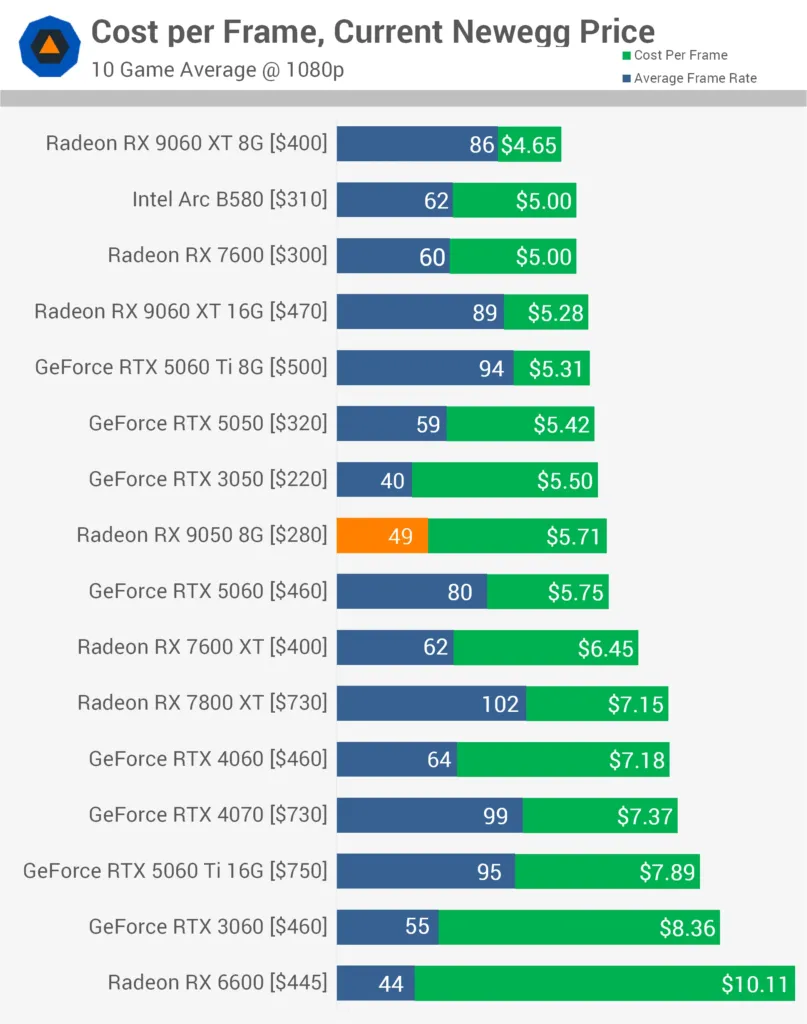
The RX 9060 XT 8GB sells for $400, which is $120 more than the RX 9050, and that’s $100 above the $300 MSRP in TechSpot’s spec table. The sticker on the box stopped meaning much a while ago. Even at the inflated street price the 9060 XT works out around 20% better value per frame, and that’s the real problem with the 9050. A card that costs less, and is also the worse deal per frame, has nothing left to argue with.
The Budget Tax
The card pitched at the tightest budgets charges the most per frame. The RX 9060 XT 8GB is around 20% better value, so anyone who can’t find another $120 ends up with the worse deal, and the people with the least to spend are the ones paying the premium.
The advice from TechSpot is to save for the RX 9060 XT, ideally the 16GB model, and the numbers back it. The 16GB card is rated at 160W against 150W for the 8GB one, a 10W difference that’s easy to live with. In Stalker 2 at 1440p the 16GB card managed 42 fps while the 8GB card collapsed to 9 fps, which puts it in the same wreckage as the 9050. If you’re stretching the budget anyway, the extra memory decides whether the extra money buys you a card that works at 1440p.
$279 and What It Buys per Frame
AMD lists the RX 9050 8GB at $279, and Club386, TopCPU, Tech Insider and Tech Times all report the same figure. TechSpot rounds it to $280 for its value maths, a dollar of difference that only matters so the numbers later in this section line up. The problem is what the money buys: on cost per frame the RX 9050 lands roughly where the RTX 5060 does, and the RTX 5060 launched at a $300 MSRP. So you get a card that’s a lot slower than its rival, priced to deliver frames at about the same cost as a card a tier above it.
That comparison comes with a catch, because the RTX 5060 isn’t selling at $300 any more. TechSpot quotes it at $460 currently, while Tech Insider had it listed at $499 in August 2026, so the street price sits well above the launch MSRP whichever source you trust. Matching the 5060 on cost per frame means matching a card that everybody already thinks is badly overpriced, and that’s a low bar to be proud of.
Intel’s Arc B580 and B570
Intel’s Arc B580 is the card that makes the RX 9050 look worst. It costs about thirty dollars more, at $310 in TechSpot’s pricing and $309.99 on Tech Insider’s list, and it’s 27% faster than the Radeon. On TechSpot’s numbers that works out to over 10% better value per frame, so the extra money more than pays for itself. It also brings 12GB on a 192-bit bus against the RX 9050’s 8GB, which means more money buys you more of everything.
| AMD RX 9050 8GB | Intel Arc B580 | Intel Arc B570 | |
|---|---|---|---|
| Price (Aug 2026) | $279 | $309.99 | $259.99 |
| VRAM | 8GB GDDR6 | 12GB GDDR6 | 10GB GDDR6 |
| Bus width | 128-bit | 192-bit | 160-bit |
| Board power | 92W | 190W | 150W |
The Arc B570 is the cheaper of the two Intel cards and undercuts AMD’s $279 outright at $259.99, with 10GB on a 160-bit bus. Both Arc cards draw far more than the Radeon’s 92W, at 150W for the B570 and 190W for the B580, so efficiency is the one column in the table AMD wins. It doesn’t matter much, though. A lower power bill and a smaller cooler don’t buy back a deficit in speed, memory and price this size.
TechSpot’s Verdict on the Price
TechSpot’s position is blunt: the RX 9050 can’t be priced above $200 and still make sense, and it says AMD might as well be spitting in budget gamers’ faces. The comparison is already tilted in AMD’s favour, since TechSpot sets the card’s $280 MSRP against what rival cards actually sell for in shops. If the RX 9050 turns up at $300 or more, the picture gets worse still.
- Don’t buy the RX 9050 at all, and shop second-hand instead
- Pick up Intel’s Arc B580 as the alternative new card
- Save up for an RX 9060 XT, ideally the 16GB version if you can afford it
The people spending the money reached the same verdict as the reviewers: the hardware is fine, the number attached to it isn’t. Some buyers put a fair price near $149.99, against the $279.99 they’re being asked for.
If this card sold for 149.99 it would a great budget GPU, but not for 279.99, that’s just ridiculous.
Buyers also landed on the used market, the same place TechSpot sent people, and they got there on their own. They keep pointing at used cards with more than 12GB of VRAM, and a used RX 6700 XT is the one that comes up by name.
Tldr : buy an 6700xt second hand or better 12+ GB vram GPU.
The 4GB OEM Card Sharing the Name
Two different cards are sold as the Radeon RX 9050, and only one of them can be bought in a box. The 4GB version was built for one specific OEM partner, AMD calls it a system-only variant, and it never ships as a standalone card. That’s what makes the shared name a problem: a spec sheet that says ‘Radeon RX 9050’ and nothing else doesn’t tell a buyer which of the two is in the machine.
Every cut is in the memory subsystem. The bus drops from 128-bit to 64-bit, bandwidth from 288 GB/s to 144 GB/s, and Infinity Cache from 32MB to 16MB, while both cards keep 16 compute units, 1,024 stream processors, 16 ray accelerators and 64 texture units. The GPU core is the same chip on paper, so the shared name isn’t a lie about the silicon. The damage is in how fast that silicon can be fed, and a core that’s already the weakest in AMD’s stack is now waiting on half the data.
| Specification | RX 9050 8GB | RX 9050 4GB |
|---|---|---|
| Architecture | RDNA 4 (Navi 44) | RDNA 4 (Navi 44) |
| Compute units / stream processors | 16 CU / 1,024 | 16 CU / 1,024 |
| Ray accelerators / texture units | 16 / 64 | 16 / 64 |
| Memory | 8GB GDDR6 | 4GB GDDR6 |
| Memory bus width | 128-bit | 64-bit |
| Memory bandwidth | 288 GB/s | 144 GB/s |
| Infinity Cache | 32MB | 16MB |
| Memory transfer rate | 18 Gbps | 18 Gbps |
| Typical board power | 92W | Not disclosed |
| Sold standalone? | Yes, $279 SRP | No — prebuilt systems only |
The rest of what’s public is thin. The spec sheet lists eight workgroup processors at 1.92 GHz, and driver support arrived with Adrenalin 26.8.1. AMD gave the 8GB card a 92W board power figure and left the 4GB card’s blank, so anyone hoping the cut memory bought a cooler, cheaper-to-run card has nothing to go on.
RX 9050 8GB vs 4GB, 18-game average at Low settings (El Chapuzas Informático)
El Chapuzas Informático ran an 18-game suite and got 107 fps from the 8GB card against 78 fps from the 4GB one, which leaves the 8GB card roughly 37% ahead. The settings were dropped to Low, and that’s the detail that matters. Turning quality down is the usual way out for a card with a thin frame buffer, and here it didn’t close the gap, so the 4GB card is being held back by more than textures not fitting.
144 GB/s is what the RX 6500 XT offered back in 2022, and the last 4GB cards before this one, the Intel Arc A310 and the GTX 1630, launched that same year, four years ago. The sharper problem is AMD’s own history: its 2020 blog argued that 4GB isn’t enough for today’s games, and it’s now shipping a 2026 card with exactly that.
So far the card lives in one machine, the CyberPowerPC Gamer Master GMA6600BST, which Best Buy lists at $889.99 and which Tom’s Hardware rounded to $900. Nobody has a confirmed price for the GPU itself. TechSpot guesses around $250 and says plainly that it’s unconfirmed, which would put it only $29 under the retail 8GB card’s $279 list price.
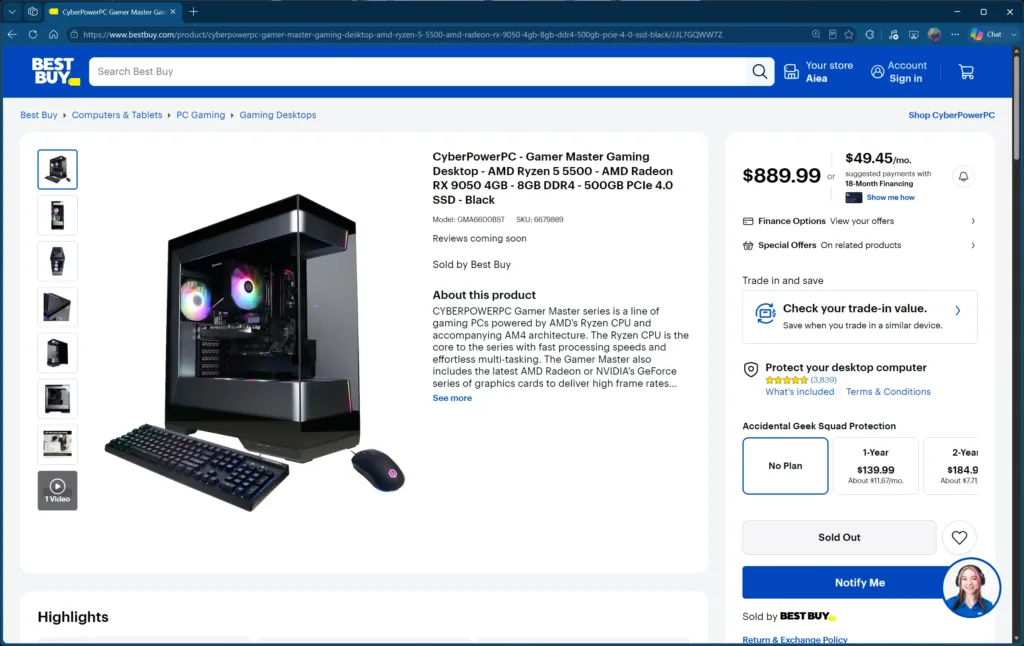
TechSpot hasn’t tested the 4GB card yet, but it expects the performance to be abysmal and says it’ll do whatever it takes to get one, with a benchmark planned eventually. Until then, the 37% gap from El Chapuzas Informático is the only head-to-head measurement of the two cards in what we were handed.
Check the memory before you pay
Before you buy a prebuilt with an RX 9050, find the memory size and memory interface in the full specification list. If it shows 4GB GDDR6, that’s the OEM card. If the listing says only ‘Radeon RX 9050′ with no capacity, call the retailer before you pay.
Prebuilt spec sheets get less scrutiny than a boxed retail card, and that’s where the two memory sizes hide behind one name. One commenter’s complaint is about exactly who ends up with the smaller one.
AMD knows that their 4GB joke of a GPU will be bought by people that don’t pay close attention to the exact specs and just want to buy a “gaming pc” within their budget. Super shameful strategy.
Power Draw, Temperatures and Fan Noise
This is the one result where the RX 9050 doesn’t need excuses, and it wasn’t gamed with an open bench: TechSpot ran a 30-minute load in a closed ATX case with the panels on, in a 21C room. The GPU hotspot settled at 59C and memory peaked at 56C, with the core clock averaging 2,770 MHz, so the card isn’t throttling itself to stay cool. The hotspot did touch 66C at the start, before the fans spun up, which tells you they stay off until the card asks for them. Once running they only got to 960 RPM, and a fan turning that slowly is one you’ll stop noticing inside a case.
| Peak GPU hotspot temperature | 59°C |
| Hotspot before fans activated | 66°C |
| Fan speed under load | 960 RPM |
| Peak memory temperature | 56°C |
| Average core clock | 2,770 MHz |
| Typical power draw | around 90W |
| Peak power draw | 92W |
| Ambient room temperature | 21°C |
| Load duration | 30 minutes |
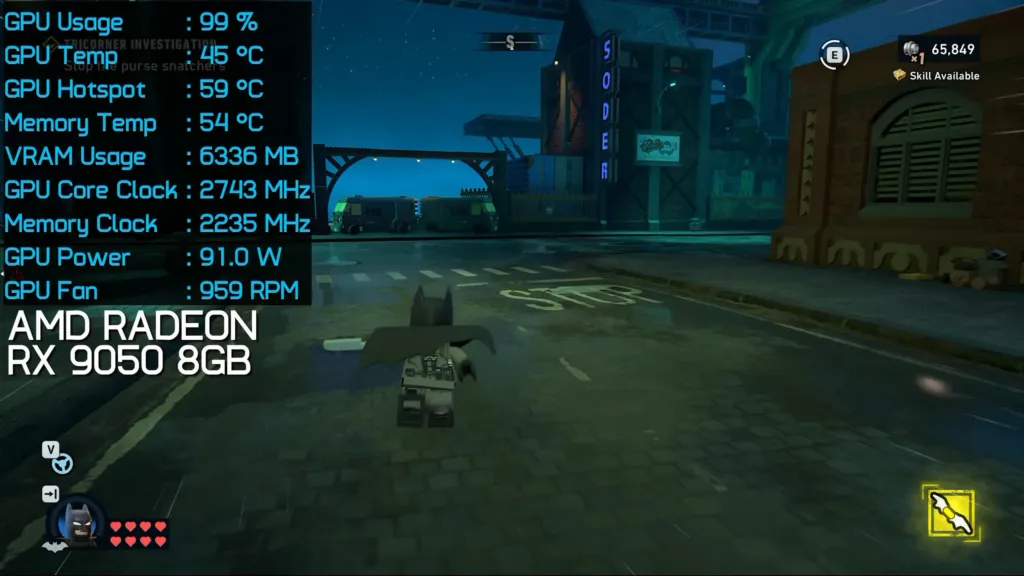
Power lines up with the spec sheet: the card peaked at 92W, which is exactly what AMD rates as typical board power. With PCIe and EPS power combined, the whole test system pulled around 180W, roughly 80W less than the same bench with an Arc B580 or an RTX 4060 Ti in it. AMD’s minimum PSU recommendation is 450W. That saving is real, but you’ve seen what it buys: 49 fps at 1080p, behind the RX 7600 and the RTX 5050. A card that sips power because it’s doing less work is a different thing from an efficient one, and the 80W gap is mostly the frame rate you didn’t get.
Total system power draw under load
The 75W Line and the 8-Pin Connector
The PCI Express slot supplies 75W on its own, and a card that stayed under that needs no power cable at all. That’s the card that drops into an office prebuilt or a small case with a weak supply and just works. The RX 9050 is 17W over the line at 92W, so it needs a single 8-pin PCIe connector, and that shuts out the builds where a 92W card would otherwise have made the most sense. TechSpot says AMD couldn’t reach 75W at this performance level, which is the uncomfortable part: a card this slow has already given up most of what a bigger one offers and still couldn’t get under the line.
17W Over the Slot Limit
The PCIe slot supplies 75W and the RX 9050 draws 92W. The gap is small, but it’s the difference between a no-cable install and one that needs an 8-pin, and the no-cable install is the only niche this card could have owned.
Partner cards don’t fix it either. Sapphire’s PULSE is a 2 slot ATX design, 200mm long, 109.25mm wide and 40.6mm high, and Sapphire lists it at 100W typical board power, higher than AMD’s 92W. No low profile RX 9050 has been announced. A cool, quiet 92W card is the obvious candidate for a small or slim build, and buyers looking for compact non-Nvidia options have noticed nobody is making one. One commenter put it this way:
Honestly, if someone makes a low profile SKU. I’m buying one. We’re starving for non-Nvidia options.
Where the RX 9050 Is Actually on Sale
July 28, 2026 was the launch date, and the card is at retail in Latin America, Asia-Pacific and Japan, with Australia and Korea cut out of that list. Nobody in the US or Europe has a date to plan around, because AMD hasn’t announced one. Even the price is unsettled: AMD puts the 8GB card at a $279 suggested price, while TechSpot tracks the retail card’s MSRP at $300. The $21 between them is the difference between AMD’s number and what a shop is expected to charge, and since we treat list prices as fiction anyway, the street figures below are the ones to plan around.
The rollout gap and the review blackout are the same problem seen from the buyer’s side. AMD wouldn’t give TechSpot a review sample, and no board partner was allowed to send one either, so the card the outlet tested came through side-channel contacts. A launch handled that way, in a handful of regions with no sanctioned samples, means that outside those markets you can’t buy the card and you can’t read a review AMD arranged for it.
Grey-Market Prices Outside Launch Regions
Where AMD hasn’t launched the card, importers are setting the price, and the listings show it. Igor’sLAB found an ASRock RX 9050 Challenger 8GB in Germany at 635.59 euros, which is more than double the $279 AMD asks for the card. Japanese shops list a Challenger at 54,800 yen, and a Russian retailer has an ASUS ROG Strix at 39,000 rubles. The currencies don’t convert cleanly into dollars here, so the German listing is the clearest evidence that scarcity, not the card, is setting the number. The Russian listing has a detail of its own: it quotes a 130W TDP, against the 92W typical board power AMD rates its reference card at. If that’s accurate, ASUS is running its board well beyond AMD’s stock figure, on a card whose reference version already draws little power.
| Market | Card | Listed price |
|---|---|---|
| Asia-Pacific / Japan / Latin America | AMD Radeon RX 9050 8GB | $279 SEP |
| Japan | Challenger RX 9050 8GB | ¥54,800 |
| Russia | ASUS ROG Strix RX 9050 | 39,000 rubles |
| Germany | ASRock RX 9050 Challenger 8GB | €635.59 |
Memory Costs Behind the Pricing
The price is already moving up before the card reaches a Western shelf. AMD put about 10% on the memory kits it sells to board partners in July 2026, its second rise in six months, and a further 10 to 15% is expected in late 2026. Partners can’t absorb that on a $279 card, so the $300 TechSpot tracks looks more like a floor than a ceiling. On some high-end boards VRAM is now over 80% of the bill of materials, which is why memory, more than the GPU die, decides what a card costs. AI data centre demand is soaking up GDDR and HBM capacity, and gamers are competing with that for supply.
- Samsung’s DRAM average selling prices rose 146% year over year.
- SK hynix reported mid-60% average selling price growth in the same quarter, well below Samsung’s figure but still steep.
- DRAM contract prices rose 171.8% year over year in Q3 2025, the highest figure of the three.
- Bit shipment volumes stayed roughly flat through all of it, so the price rises came from tight supply rather than from anyone shipping more memory.
Nvidia’s stack shows what that pressure does at US retail, where RTX 50 cards sit 50 to 90% above MSRP. The RTX 5050 launched at $249 and now sells around $320, and the RTX 5060 launched at $300 and now goes for $460. TechSpot scored the RX 9050 against those street prices rather than the launch ones, and warned that a $300 RX 9050 would be a bigger disaster. That’s the buyer’s real problem: $279 is only a good offer while rival cards cost what they do now, and an RX 9050 that arrives in the US at $300 or more has to be judged on the same terms.
The RX 9070 GRE Precedent
AMD has held a card back like this before. The RX 9070 GRE launched China-only on March 6, 2025 and didn’t go on global sale until June 2, 2026, when AMD normally launches desktop cards globally within weeks. That’s a precedent for the RX 9050 eventually reaching the US and Europe, and it’s also a warning that eventually can mean more than a year.
What the Reviewers Concluded About the RX 9050
Efficiency is the one place the RX 9050 comes out ahead. TechSpot measured the card at 92W, and the whole system pulled around 180W, which is about 80W less than systems built around the Arc B580 or the RTX 4060 Ti. MW Consultoria, a separate tester, has the same 92W against 130W for the RTX 5050, so the two comparisons come from different benches and still point the same way. The cooler side backs it up: the hotspot peaked at 59°C with the fans turning at 960 RPM. It isn’t worth much, though. TechSpot’s own take is that low power is less exciting when the card is this slow, and a card that runs cool and quiet at 49 fps is still a card running at 49 fps.
Reviewers didn’t split on this one. TechSpot is the harshest, saying that at $280 the RX 9050 need not exist and that it can’t be priced above $200 to make any sense. topcpu doesn’t recommend it to anybody on a tight budget and points them to a used GPU, the RX 9060 XT or the Arc B580 instead. Club386 comes at it from the other end: it called the 60fps result in 007: First Light a red flag and doubts the card will last as games get harder, which matters if you were hoping a cheap card would at least age gracefully.
- TechSpot: at $280 the RX 9050 makes no sense and need not exist.
- TechSpot: the card can only work priced below $200.
- topcpu: not recommended for buyers on a tight budget.
- Club386: unlikely to have a long lifespan as games grow more demanding.
- TechSpot: buyers who can’t afford more are getting screwed.
Nobody’s arguing budget gamers don’t need cheap cards, and TechSpot says outright that the market needs more of them. The trouble is that a new product only as good as what’s already on the shelf defeats the purpose, and this one is worse: the RX 9050 is 22% slower than the older RX 7600. Step up to the Arc B580 at $310 and it’s 27% faster than the RX 9050 with over 10% better value per frame, so the extra money buys more than it costs.
The Memory Squeeze Behind the Launch
Tech Insider reads the RX 9050 as less a graphics card than a symptom. Samsung reported DRAM average selling prices up 146 percent year-over-year in Q1 2026, and SK hynix posted a mid-60 percent jump in the same quarter, with GDDR6 and GDDR7 prices climbing faster than at any point since 2021. AMD hadn’t released a new desktop GPU in nearly a year, so it was under pressure to put something out while memory was getting dearer, and a cut-down card at $279 is what that pressure produced.
- Nvidia holds official MSRPs steady while street prices float upward, and buyers pay 50 to 90 percent premiums at retail.
- AMD cuts memory bus width and routes cheap SKUs through OEMs, and its 4GB RX 9050 uses a 64-bit bus and 144 GB/s of bandwidth.
- Intel holds Arc B570 and B580 pricing and leans on VRAM, with 10GB on the Arc B570 and 12GB on the Arc B580.
| GPU | Price (Aug 2026) | VRAM | Bus width | Board power |
|---|---|---|---|---|
| Intel Arc B570 | $259.99 | 10GB GDDR6 | 160-bit | 150W |
| AMD RX 9050 8GB | $279 (APAC/LatAm) | 8GB GDDR6 | 128-bit | 92W |
| Nvidia RTX 5050 | $299.99 | 8GB GDDR6 | 128-bit | 130-135W |
| Intel Arc B580 | $309.99 | 12GB GDDR6 | 192-bit | 190W |
Whenever the RX 9050 reaches the US, Tech Insider expects it to cost more than $279. AMD raised memory kit prices to board partners by about 10% in July 2026 and a further 10 to 15% increase is expected in the second half, so partners are paying more before a card is even built. AMD hasn’t announced a North American or European retail date, and Igor’sLAB has already listed an ASRock RX 9050 Challenger 8GB at €635.59 in Germany, which shows what the gap looks like when nobody’s holding the price down. Read the table above with that in mind: the Arc B570 at $259.99 is the cheapest card on it, with 10GB against the RX 9050’s 8GB.
- Tech Insider expects the RX 9050 8GB to land in US retail above $279.
- Tech Insider expects the Arc B580 to gain sub-$350 market share.
- Tech Insider expects $500 to $700 prebuilts to ship with 4GB or 6GB GPUs.
- Tech Insider expects prebuilt prices in that bracket to rise 10-15% into 2027.
- Tech Insider expects DRAM and GDDR prices to stay elevated through mid-2027.
If the shortage keeps going, Tech Insider expects the Arc B580 to take budget market share on VRAM alone, since its memory advantage grows the longer the crisis lasts. That suits anybody planning to keep a GPU four-plus years. Meanwhile budget prebuilts increasingly ship with 4GB or 6GB GPU configurations, and the practical advice is dull but worth following: ask what GPU memory a prebuilt actually contains before you pay for it.
Buyers have criticised both AMD and Nvidia over budget GPU pricing, and TechSpot’s view is that people on tight budgets get screwed hardest by both. AMD had an opening to look better than Nvidia here and ended up standing next to it instead, which one commenter summed up in two lines.
Everyone: *is mad at Nvidia* AMD: “Wait me too!”