
Key Takeaways
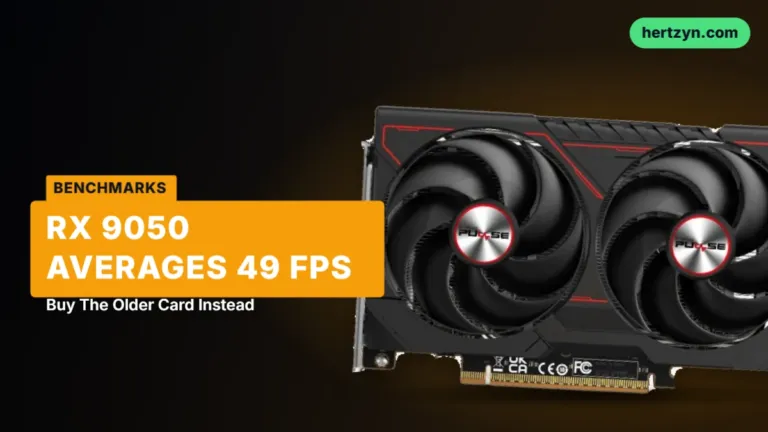
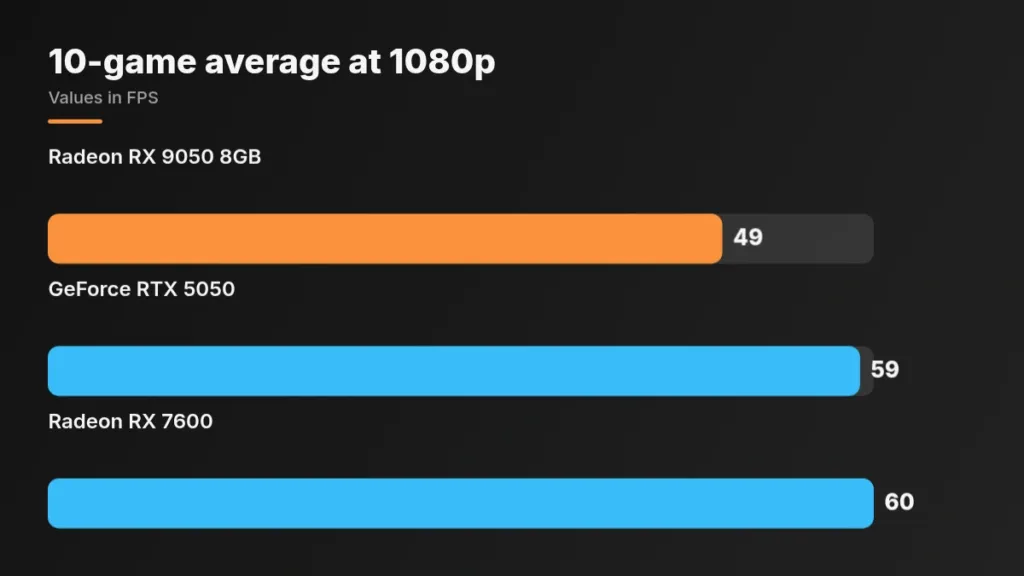
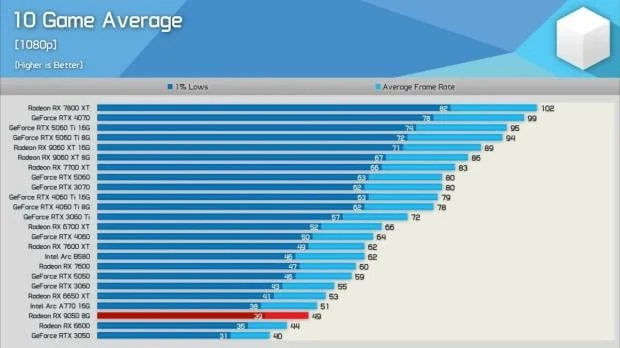
- 1The RX 9050’s $279 MSRP buys a card that TechSpot measured 20% slower than the RTX 5050 at 1080p across 10 games, 49 FPS against 59 FPS.
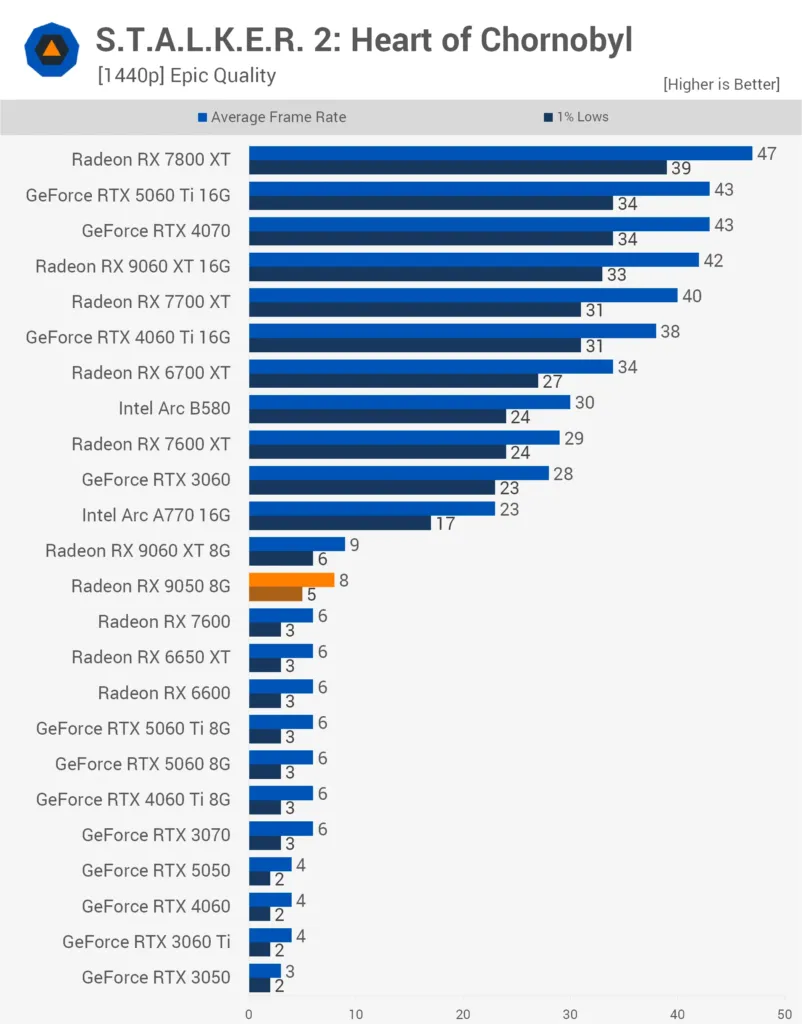
- 2Don’t buy either card expecting real 1440p performance: TechSpot found the RX 9050 and RTX 5050 both collapse to a tied 33 FPS at 1440p once their shared 8GB of VRAM runs out, and Stalker 2 drops the RX 9050 to just 8 FPS at that resolution.
- 3AMD’s own RX 9060 XT 8GB costs $120 more at $400 but delivers roughly 20% better value per frame than the RX 9050, according to TechSpot, which makes it the better place to spend the extra money if the budget stretches.
- 4The RX 9050 loses to the 2-generation-old RX 7600 by as much as 41% in some of TechSpot’s games, so shoppers comparing new silicon against older stock shouldn’t assume newer means faster here.
- 5The only category the RX 9050 wins is power draw, pulling about 35W less than the RTX 5050 under load – a real advantage for a small-form-factor build, but not one that makes up for losing on frame rate.
The Silicon: Navi 44 XE
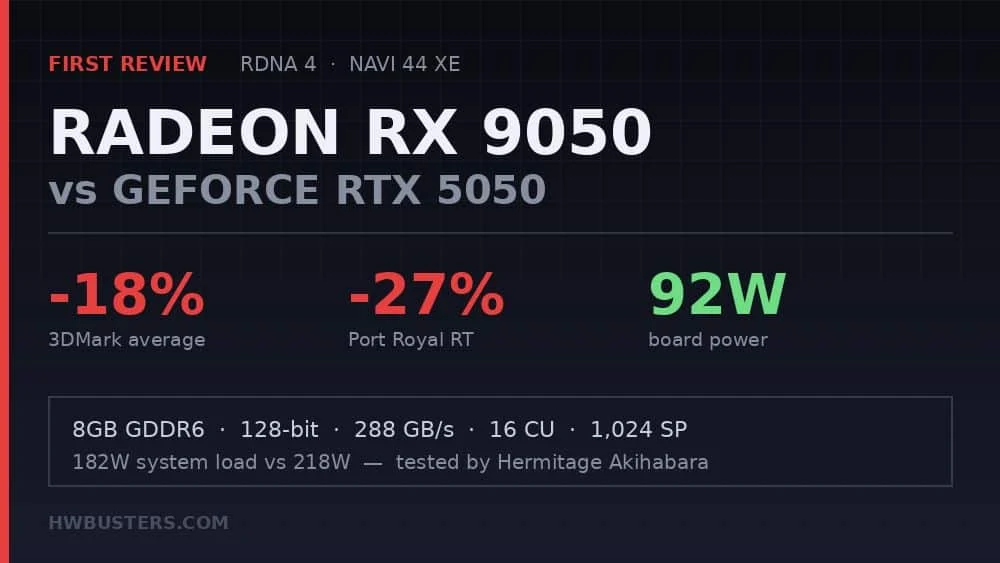
Pull the BIOS on an RX 9050 and it doesn’t say RX 9050. It says Navi 44 XE, and that name is the whole story: this is the same die that ships in the RX 9060 XT, hacked down to 16 Compute Units and 1,024 stream processors, with 16 ray accelerators and 32 AI accelerators left standing. The die itself hasn’t shrunk – it’s still 199 mm2 on TSMC N4P, still carrying 29.7 billion transistors – AMD has just switched off most of what’s on it.
| Spec | Radeon RX 9050 8GB | Radeon RX 9060 | Radeon RX 9060 XT |
|---|---|---|---|
| Core config | 1024 / 64 / 64 | 1792 / 112 / 64 | 2048 / 128 / 64 |
| GPU boost clock | 2600 MHz | 2990 MHz | 3130 MHz |
| Memory capacity | 8 GB | 8 GB | 8 GB |
| Memory speed | 18 Gbps | 18 Gbps | 20 Gbps |
| Bus / bandwidth | 128-bit : 288 GB/s | 128-bit : 288 GB/s | 128-bit : 320 GB/s |
| Total board power | 92W | 132W | 150W |
| Price (MSRP) | $280 | OEM | $300 |
Walk down the ladder and the cuts get brutal fast. The RX 9060 XT needs 2,048 working cores out of that die, the OEM-only RX 9060 settles for 1,792, and the RX 9050 ships with just 1,024 – half of what the XT runs. Reviewers’ working theory is that this is where the dies too broken even for a 9060 end up: a bin of last resort rather than a product designed from scratch. AMD hasn’t confirmed that’s what’s happening, but nobody’s offered a better explanation for a card running on half a chip.
AMD’s reference spec lists a 2,600 MHz boost and, per Hardware Busters, a 1,920 MHz game clock – against the RX 9060 XT’s 3,130 MHz boost. TechSpot’s actual sample ran a bit hotter than that sheet suggests, holding between 2.7 and 2.8 GHz and averaging 2,770 MHz across testing. Going in, TechSpot read the core count and clock gap and expected roughly half the 9060 XT’s performance before a single benchmark ran.
| Architecture | RDNA 4 |
| GPU code name | Navi 44 XE |
| Compute Units | 16 |
| Stream processors | 1,024 |
| Ray accelerators | 16 |
| AI accelerators | 32 |
| Process | TSMC N4P |
| Die size | 199 mm2 |
| Transistors | 29.7 billion |
| Game clock | 1,920 MHz |
| Boost clock | 2,600 MHz |
| Memory | 8GB GDDR6 at 18 Gbps |
| Memory bus | 128-bit |
| Memory bandwidth | 288 GB/s |
| Board power | 92W |
| Power connector | 1x 8-pin |
| Release date | 28 July 2026 |
| MSRP | $279 |
92W is a low number for a desktop GPU, but TechSpot’s measured peak draw of 92W still sits above the 75W ceiling a card would need to run off the PCIe slot alone with no cable at all. TechSpot’s point is that this was never within reach here – even cut down this far, the card still needs its one 8-pin connector.
Launch Date, Price and Availability
AMD launched the RX 9050 on 28 July 2026 at a $279 MSRP, which some reviewers just write as $280. It isn’t launching everywhere, or really anywhere that matters to most readers of this site: Asia-Pacific, Japan and Latin America only, with Australia and Korea cut out even within that list, and no date at all set for North America or Europe. Japan got retail stock on 31 July, and GameGPU tracked the street price there at $348 – already well clear of the number AMD put on the box.
The Other RX 9050: Same Name, Half the VRAM
There’s a second card wearing the exact same name, and it’s worse in every way that matters. The 4GB RX 9050 is OEM and prebuilt-only, with its memory bus halved to 64-bit and bandwidth cut to 144 GB/s. AMD has confirmed it’ll show up in at least one prebuilt PC, though not at what price – TechSpot’s educated guess lands it near $250. If you’re shopping prebuilts, check the VRAM number on the sticker, not just the model name.
| Spec | Radeon RX 9050 4GB | Radeon RX 9050 8GB |
|---|---|---|
| Price (MSRP) | OEM | $280 |
| Memory capacity | 4 GB | 8 GB |
| Bus type / bandwidth | 64-bit : 144 GB/s | 128-bit : 288 GB/s |
| Memory speed | 18 Gbps | 18 Gbps |
| Core config | 1024 / 64 / 64 | 1024 / 64 / 64 |
| GPU boost clock | 2600 MHz | 2600 MHz |
| Total board power | 92W | 92W |
| Release date | July 28, 2026 | July 28, 2026 |
GDM’s 3DMark Showdown: ASRock RX 9050 vs Gigabyte RTX 5050
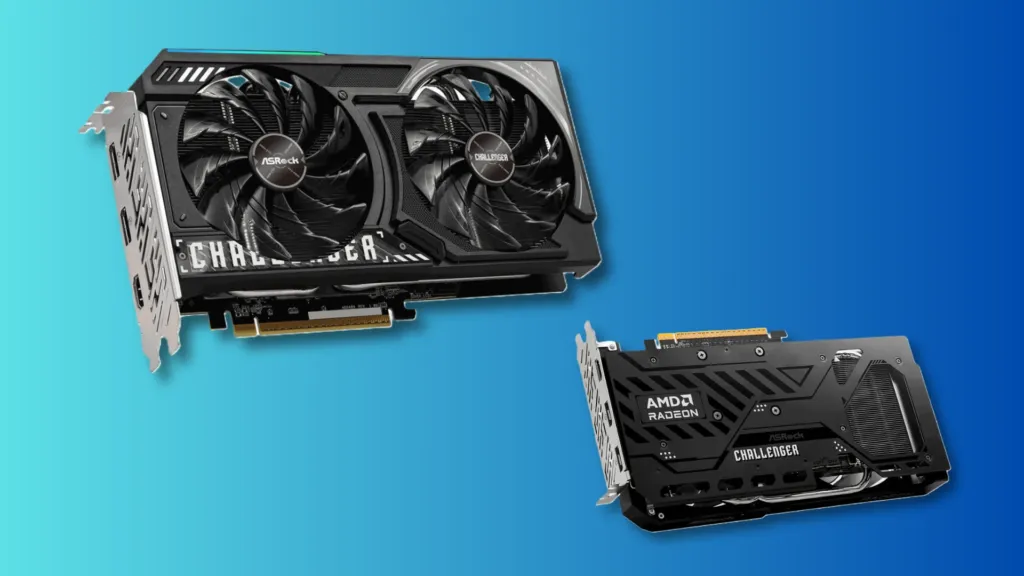
Hermitage Akihabara built this test around an ASRock RX 9050 Challenger 8GB and a Gigabyte RTX 5050 Windforce OC 8GB, both sitting behind a Ryzen 7 9800X3D so the CPU isn’t the thing holding either card back. Both cards carry 8GB, so there’s no VRAM mismatch skewing anything, and 3DMark doesn’t touch upscaling or frame generation at all. That makes this the one comparison in the whole launch where nobody’s software tricks are doing any of the work — just the silicon, measured straight.
| Benchmark | AMD Radeon RX 9050 | NVIDIA GeForce RTX 5050 | RX 9050 deficit |
|---|---|---|---|
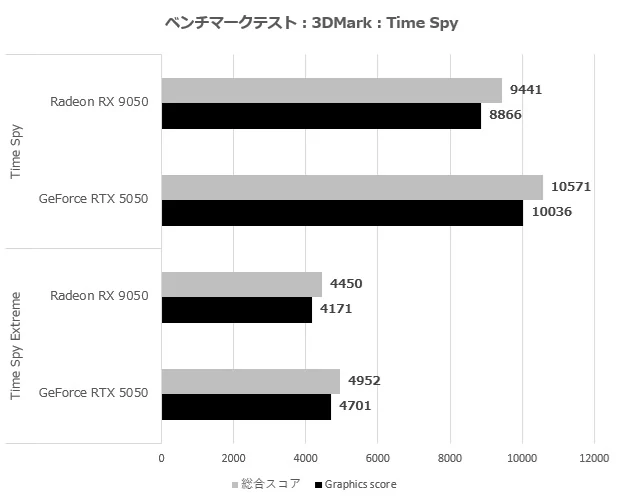
| 3DMark Time Spy | 9,441 | 10,571 | -10.7% |
| 3DMark Time Spy Extreme | 4,450 | 4,952 | -10.1% |
| 3DMark Steel Nomad | 1,985 | 2,282 | -13.0% |
| 3DMark Speed Way | 1,873 | 2,520 | -25.7% |
| 3DMark Port Royal | 4,531 | 6,181 | -26.7% |
On the raster side, the RX 9050 actually holds together. Time Spy puts it at 9,441 against the RTX 5050’s 10,571, a gap of roughly 11% and the best result the card posts anywhere in this suite. Time Spy Extreme narrows that further still: 4,450 against 4,952, which Tom’s Hardware measured at a 10.1% deficit. Steel Nomad opens the gap a bit, 1,985 against 2,282 for a 13% shortfall, but that’s still a card losing by a margin most buyers wouldn’t notice without a chart in front of them.
Switch to the ray-traced tests and the card falls apart. Speed Way puts the RX 9050 at 1,873 against the RTX 5050’s 2,520, a 25.7% deficit, and Port Royal is barely different: 4,531 against 6,181, down 26.7%. Both are more than double anything the card lost by on the raster side. That tracks with what’s sitting on the die, 16 ray accelerators is a cut-down allowance to begin with, and this is exactly the kind of workload that number was always going to struggle against.
3DMark Port Royal and Speed Way
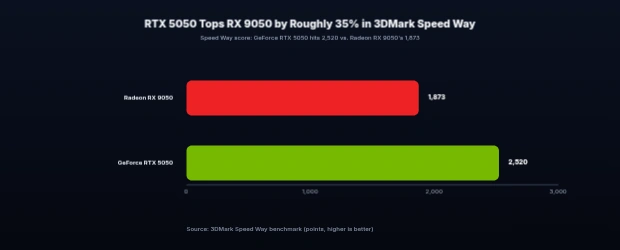
Fire Strike lands somewhere in between, and the two reviewers who ran it don’t quite agree on the number: Hardware Busters puts the gap at 21% to 23%, PCMag has it over 23%. What matters more than either figure is how the RX 9050 behaves across resolutions — steady at Full HD, then falling apart sharply at 4K, which GameGPU puts down to the hardware limits of the chip itself rather than anything a driver update would fix.
Pull the whole suite together and the reviewers don’t land on quite the same single number, because they’re summarizing the same spread differently. Tom’s Hardware calls it almost 20% behind overall. Hardware Busters averaged eight 3DMark results and got roughly 18%. GameGPU skips the single average entirely and just reports the range as it actually runs: 11% to 30% depending on which test you’re looking at. That range is the honest version of this whole section, a raster-leaning buyer sees something closer to 11%, a ray tracing buyer sees something closer to 30%, and the single-number summaries are just picking a point to stand on inside that spread.
Apex Legends, Rainbow Six Siege X and Final Fantasy XIV
Apex Legends is the cleanest picture of the pattern running through all of GDM’s non-frame-gen tests. At 1080p max settings the RX 9050 manages 147.1 FPS against the RTX 5050’s 192.4 FPS, and at 1440p that’s 101.4 against 128.2. Both numbers clear 100 FPS at Full HD either way, so a buyer chasing a high refresh monitor gets a smooth esports title from both cards, just a noticeably smoother one from the GeForce. At 4K the gap collapses to 72.6 FPS against 74.8 FPS, 3% apart, and it’s tempting to read that as the Radeon catching up. It isn’t. 72.6 FPS at 4K is a different, heavier workload than 147.1 FPS at 1080p, and when a game stops caring about shader count and starts caring about something else, the two cards converge because neither is being pushed by its strength anymore.
Apex Legends, Max Settings
Read the write-ups of that same Apex run and the deficit quoted depends entirely on which rows got averaged. Tom’s Hardware calls it 30.8% at 1080p, Wccftech puts it at 26-30% lower, Club386 lands at 21-23% across FHD and QHD together, and Hardware Busters settles on 23.5%. None of them measured anything different from the others; they’re reading the same chart and folding different resolutions into their headline number.
| Game / preset | Resolution | AMD Radeon RX 9050 | NVIDIA GeForce RTX 5050 |
|---|---|---|---|
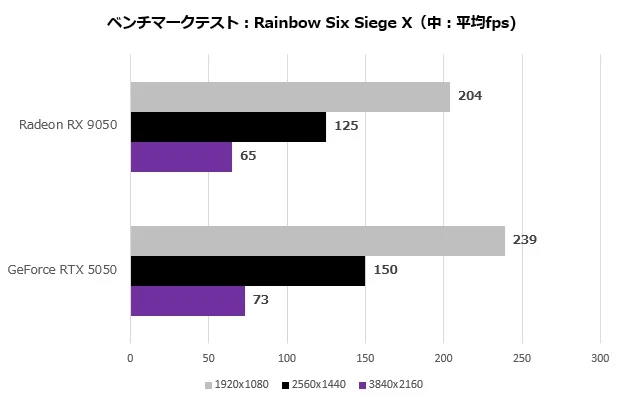
| Rainbow Six Siege X — Medium | 1080p | 204.0 FPS | 239.0 FPS |
| Rainbow Six Siege X — Medium | 1440p | 125.0 FPS | 150.0 FPS |
| Rainbow Six Siege X — Medium | 4K | 65.0 FPS | 73.0 FPS |
| Rainbow Six Siege X — Ultra+ | 1080p | 129.0 FPS | 141.0 FPS |
| Rainbow Six Siege X — Ultra+ | 1440p | 116.0 FPS | 126.0 FPS |
| Rainbow Six Siege X — Ultra+ | 4K | 64.0 FPS | 64.0 FPS |
Rainbow Six Siege X runs the Apex pattern backwards and forwards at the same time. On Medium, where frame rates are highest, the RX 9050 gives up the most ground: 204 FPS against 239 FPS at 1080p, 125 against 150 at 1440p, 65 against 73 at 4K, with both cards still clearing 100 FPS at Full HD. Tom’s Hardware calls the worst of that a 20% deficit at 1440p Medium, Hardware Busters reads the 1080p Medium row at 14.6%, and Wccftech just calls the whole game 20% behind — three ways of counting the same chart. Switch to Ultra+ and the numbers tighten on their own: 129 against 141 at 1080p, 116 against 126 at 1440p, and at 4K the two cards land on the exact same 64 FPS. That’s the opposite of what a weaker shader count should produce under heavier load, and it says whatever is capping both cards at 4K Ultra+ isn’t the RX 9050’s compute budget.
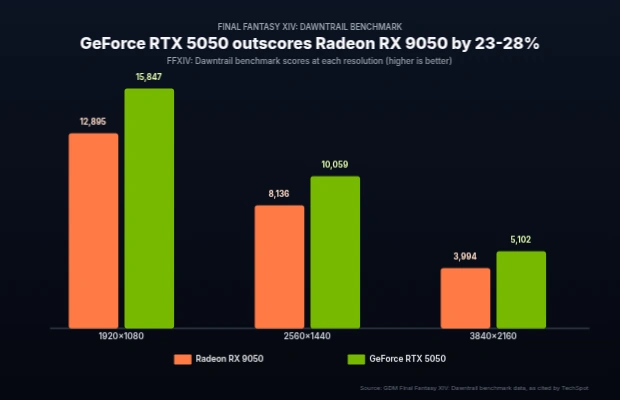
Final Fantasy XIV: Dawntrail breaks the trend the other 2 games set up. The scores run 12,895 points against 15,847 at 1080p, 8,136 against 10,059 at 1440p, and 3,994 against 5,102 at 4K, and in Tom’s Hardware’s reading the deficit grows as the resolution climbs, from 22.9% up to 27.7%. PCMag’s numbers move the same direction, almost 19% at 1080p rising past 21% at 4K. But the two reviewers don’t even agree on the starting point: Hardware Busters reads that same 1080p row as 18.6% behind, four points under Tom’s Hardware’s 22.9%, on the identical benchmark run. Wccftech splits the difference at 23-27% slower across the board. Whichever number a buyer trusts, FFXIV is the one game here where the RX 9050 doesn’t claw any ground back at higher resolutions.
Final Fantasy XIV: Dawntrail, Standard preset
The pattern behind the convergence
Line up Apex and Siege X and the shape repeats: the RX 9050 loses the most ground exactly where frame rates are highest and the settings are lightest, then the gap shrinks toward nothing as the load gets heavy enough, right down to an identical 64 FPS on Siege X Ultra+ at 4K and a 3% split on Apex at 4K. That’s not the RX 9050 finding its footing. It’s both cards running into the same ceiling at once, which means those 4K numbers describe a limit neither card is built to clear, not a comeback either card is making.
FSR Frame Gen vs DLSS Multi-Frame Gen
Four of GDM’s games don’t compare the two cards on equal footing: Cyberpunk 2077, Onimusha: Way of the Sword, Assassin’s Creed Black Flag Remake and DOOM: The Dark Ages all ran with the Radeon on standard FSR frame generation while the GeForce ran DLSS multi-frame generation at 4x or 6x. That’s a settings choice rather than a straight hardware test, except there was no fix available: FSR frame gen on the RX 9050 tops out at 2x, so there’s no toggle GDM could have flipped to put the Radeon on the same footing as the GeForce. Whatever gap shows up across these four games has that ceiling baked into it before either card renders a frame.
4 reviewers looked at the same mismatch and reached for different fixes. PCMag said some of these results should be thrown out entirely. wccftech skipped the frame-gen titles in its own coverage rather than publish them. Club386 declined to comment on the ray traced gaming numbers at all. Hardware Busters flagged several of the bigger gaps as not being clean comparisons. 4 reviewers landing on the same complaint independently, without coordinating, is about as close to a consensus as this test produces.
Cyberpunk 2077 and Onimusha: Way of the Sword
| Game | Preset | Resolution | AMD Radeon RX 9050 | NVIDIA GeForce RTX 5050 |
|---|---|---|---|---|
| Cyberpunk 2077 | Ultra | 1080p | 142.01 FPS | 241.72 FPS |
| Cyberpunk 2077 | Ultra | 1440p | 87.51 FPS | 147.39 FPS |
| Cyberpunk 2077 | Ultra | 4K | 40.42 FPS | 77.19 FPS |
| Cyberpunk 2077 | Medium | 4K | 64.27 FPS | 107.47 FPS |
| Onimusha: Way of the Sword | Medium | 1080p | 134.97 FPS | 166.60 FPS |
| Onimusha: Way of the Sword | Ultra | 1440p | 86.43 FPS | 128.51 FPS |
| Onimusha: Way of the Sword | Ultra | 4K | 53.33 FPS | 92.13 FPS |
At Ultra 1080p in Cyberpunk 2077, the Radeon manages 142.01 FPS against the GeForce’s 241.72 FPS, a lead large enough that even the percentage describing it depends on who’s doing the arithmetic. Hardware Busters puts it at 41%; Tom’s Hardware puts the identical row at 70.2%. Both figures come off the same GDM run, so the gap itself isn’t in dispute, only how it gets expressed. At 4K the margin survives the resolution jump, 40.42 FPS against 77.19 FPS, and Onimusha: Way of the Sword at Ultra 4K lands at 53.33 FPS against 92.13 FPS, the widest gap of any game here, with the RTX 5050 running nearly twice as fast.
Assassin’s Creed Black Flag Remake is the fourth game running mismatched frame gen, and it tells much the same story from a different angle. Hardware Busters puts Nvidia’s lead at nearly 58%, while GameGPU recorded the Radeon hitting 57 FPS at maximum settings on its own run. GameGPU’s wider pass across the heavier games found FSR with frame generation kept the RX 9050 between 80 and 114 FPS at Full HD, which is playable, it just isn’t what the Nvidia side of this comparison is actually measuring against it.
DOOM: The Dark Ages Flips at Higher Resolutions
| Game | Preset | Resolution | AMD Radeon RX 9050 | NVIDIA GeForce RTX 5050 |
|---|---|---|---|---|
| DOOM | Medium | 1080p | 132.74 FPS | 296.63 FPS |
| DOOM | Medium | 1440p | 85.11 FPS | 17.17 FPS |
| DOOM | Medium | 4K | 39.71 FPS | 9.87 FPS |
| DOOM | Ultra Nightmare | 1080p | 114.17 FPS | 280.13 FPS |
| DOOM | Ultra Nightmare | 1440p | 73.79 FPS | 10.71 FPS |
| DOOM | Ultra Nightmare | 4K | 35.56 FPS | 9.62 FPS |
DOOM: The Dark Ages opens the way the other 3 mismatched games do: at Medium 1080p the GeForce more than doubles the Radeon, 296.63 FPS against 132.74 FPS. Then it reverses. At Medium 1440p the Radeon’s 85.11 FPS beats the GeForce’s 17.17 FPS, and at Ultra Nightmare 1440p the gap is 73.79 FPS against 10.71 FPS. Push to 4K and the GeForce sits at 9.62 to 9.87 FPS across both presets while the Radeon still clears 35 FPS. Read those rows in order and the RTX 5050 looks like it fell off a cliff somewhere between 1080p and 1440p.
Not a Radeon Win
That cliff is VRAM, not speed. The RTX 5050 is blowing through its 8GB frame buffer once DOOM’s multi-frame generation gets layered on top of 1440p and 4K rendering, and that’s what collapses it to 10 to 17 FPS rather than anything the Radeon is doing better. The RX 9050 holding 73.79 FPS at Ultra Nightmare 1440p isn’t the Radeon pulling ahead on merit, it’s the GeForce running out of memory to generate frames with. Reading these DOOM rows as proof the RX 9050 wins means reading a memory limit as a performance result.
Averaged Deficits Across the Losses
RX 9050 deficit against RTX 5050, averaged across Final Fantasy XIV, Cyberpunk 2077 and Onimusha
Tom’s Hardware averaged the three games where the RX 9050 lost at every resolution and every preset: Final Fantasy XIV, Cyberpunk 2077 and Onimusha: Way of the Sword. The deficit grows as resolution climbs, 31% slower at 1080p, 34% slower at 1440p, and 42% slower at 4K. Worth remembering that average still includes the frame-gen-mismatched Cyberpunk and Onimusha numbers, so it isn’t a clean rasterization comparison either. It’s the gap GDM’s settings produced, not the gap between the two cards running the same workload.
TechSpot’s Game-by-Game Results at 1080p and 1440p
This suite exists because AMD decided it shouldn’t. AMD wouldn’t supply TechSpot with a review sample, and no AMD partner was permitted to send one either, so TechSpot got hold of a card through side-channel contacts instead and can’t name or show the model it ended up testing. Whatever card it was, the bench around it was a controlled one: a Ryzen 7 9800X3D doing the CPU work and Radeon Adrenalin 26.7.1 WHQL driving the card, across 10 games at both 1080p and 1440p. That’s the context for every number below – this is TechSpot’s own run, not numbers scraped off a spec sheet AMD was happy to publish.
| Game | Preset | RX 9050 8GB (1080p) | RTX 5050 (1080p) |
|---|---|---|---|
| Clair Obscur: Expedition 33 | Epic | 36 fps | 39 fps |
| Marvel Rivals | Ultra | 41 fps | 50 fps |
| Star Wars Jedi: Survivor | — | 57 fps | 70 fps |
| A Plague Tale: Requiem | Ultra | 53 fps | 61 fps |
| Cyberpunk 2077: Phantom Liberty | High | 67 fps | 72 fps |
| Marvel’s Spider-Man Remastered | Very High | 104 fps | 124 fps |
| Hogwarts Legacy | High | 56 fps | 70 fps |
| Starfield | Ultra | 34 fps | 41 fps |
| Stalker 2: Heart of Chornobyl | Epic | 33 fps | 33 fps |
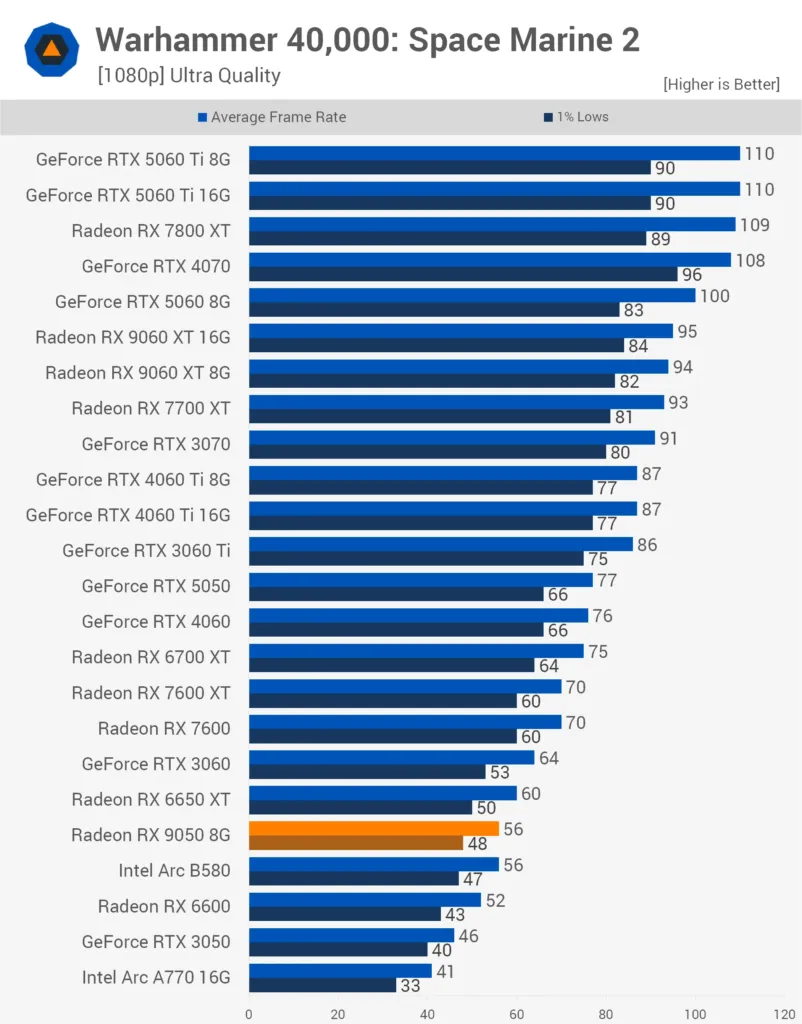
| Warhammer 40,000: Space Marine 2 | Ultra | 56 fps | 77 fps |
Even at 1080p, at the presets TechSpot picked, the RX 9050 can’t hold 60 fps in most of these games. Clair Obscur: Expedition 33 lands at 36 fps, Marvel Rivals at 41 fps, Starfield at 34 fps, Stalker 2: Heart of Chornobyl at 33 fps, and Jedi Survivor, Hogwarts Legacy and Space Marine 2 all sit in the mid-50s – 57, 56 and 56 fps respectively. Only Marvel’s Spider-Man Remastered at 104 fps and Cyberpunk 2077: Phantom Liberty at 67 fps clear 60 with room to spare. The margin to the RTX 5050 isn’t a fixed number you can apply across the board; it swings from a dead tie in Stalker 2 and a 7% gap in Phantom Liberty up to a 38% gap in Space Marine 2, where the RTX 5050’s 77 fps leaves the RX 9050’s 56 fps well behind. And in Jedi Survivor, where the RX 9050 managed 57 fps against the RTX 5050’s 70, the RX 7600 – a card 2 generations old – posted 72 fps in the same test, ahead of both of them.
| Game | RX 9050 8GB (1440p) | RTX 5050 (1440p) |
|---|---|---|
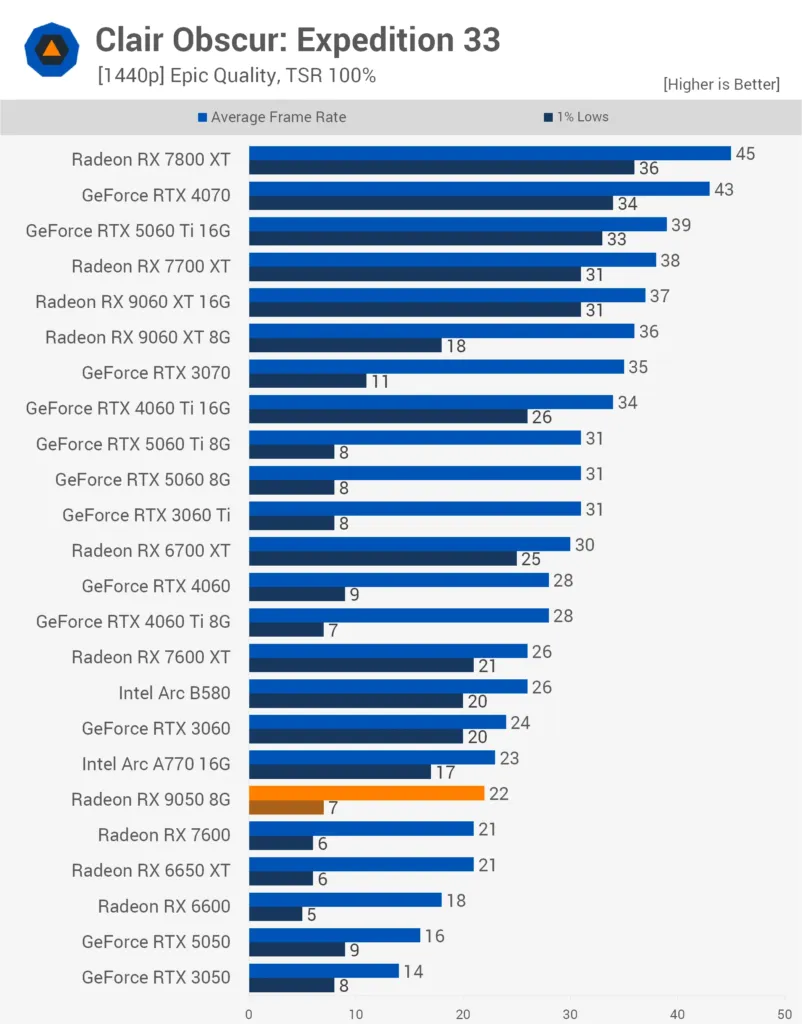
| Clair Obscur: Expedition 33 | 22 fps | 16 fps |
| Marvel Rivals | 27 fps | 30 fps |
| A Plague Tale: Requiem | 32 fps | 42 fps |
| Cyberpunk 2077: Phantom Liberty | 44 fps | 51 fps |
| Marvel’s Spider-Man Remastered | 65 fps | 86 fps |
| Hogwarts Legacy | 43 fps | 55 fps |
| Starfield | 26 fps | 32 fps |
| Warhammer 40,000: Space Marine 2 | 39 fps | 53 fps |
Push either card to 1440p at these same presets and the RX 9050 mostly stops being a gaming card at all: 22 fps in Clair Obscur, 26 in Starfield, 27 in Marvel Rivals, 32 in A Plague Tale: Requiem, and 39 in Space Marine 2. Spider-Man’s 65 fps is the one result in this table a buyer could actually play at. The two rows where the RX 9050 beats the RTX 5050 – Clair Obscur’s 22 fps to 16 fps and nothing else – don’t mean what a win usually means. A 38% lead at 22 fps over a card stuck at 16 fps is still 2 cards failing the same test; nobody buying a graphics card wants to know which one fails less.
Stalker 2: The VRAM Wall
Stalker 2 at 1440p Epic isn’t a speed problem, it’s a memory one. The RX 9050 8GB falls to 8 fps, and the far faster RX 9060 XT 8GB does barely better at 9 fps – more Compute Units and stream processors buy almost nothing once the 8GB buffer runs out. The identical RX 9060 XT with 16GB holds 42 fps in the same test. For anyone shopping at this price, that’s the real lesson: the number on the box that decides whether a game runs at all isn’t the shader count, it’s the VRAM.
Stalker 2: Heart of Chornobyl, 1440p Epic
The 10-Game Average at Both Resolutions
10 games, averaged together, is where the marketing stops and the truth sits: 49 FPS at 1080p for the RX 9050, against 59 FPS for the RTX 5050, a 20% gap TechSpot measured across the whole suite rather than one cherry-picked title. That’s not a card losing a close race. That’s a card sitting near the bottom of anything built on current silicon that you’d actually hand over money for new.
10-game average at 1080p
Line the old guard up next to it and the picture gets worse before it gets better. The RX 7600, a card from 2 generations back, averaged 60 FPS at 1080p and beats the RX 9050 by 22%. The only direction the RX 9050 wins is down: it’s 23% ahead of the RTX 3050 and just 11% ahead of the RX 6600, 2 cards nobody walks into a store to buy new in 2026. Beating those isn’t a selling point, it’s a floor.
Push both cards to 1440p and the 10-game average drops to 33 FPS for the RX 9050 – and the RTX 5050 lands at exactly the same 33 FPS. Don’t read that as the Radeon closing the gap. Native 1440p at higher-quality settings is simply a tall order for this class of card, full stop, and both of these cards are finding that out at the same spot on the chart.
| Graphics card | 10-game average 1080p | 10-game average 1440p |
|---|---|---|
| Radeon RX 9050 8GB | 49 FPS | 33 FPS |
| GeForce RTX 5050 | 59 FPS | 33 FPS |
| Radeon RX 7600 | 60 FPS | 35 FPS |
The field above it reshuffles once you hit 1440p. The RX 7600’s lead shrinks to just 6%, down from 22% at 1080p, while the older cards below it fall further behind: the RX 9050 now holds a 50% advantage over the RTX 3050 and a 27% advantage over the RX 6600, both wider than their 1080p margins. That’s not the RX 9050 getting stronger relative to the field. It’s everything above it losing ground at the same resolution, which pulls the pack down to meet the RX 9050 rather than the RX 9050 climbing up to meet the pack.
The 1440p tie is a VRAM story, not a comeback
Don’t let the matching 33 FPS scores at 1440p fool you into thinking the RX 9050 caught up. At 1080p it’s 20% behind the RTX 5050, full stop, and that’s the real measure of where these two GPUs stand. At 1440p both cards carry the same 8GB of VRAM, and both are hitting that ceiling at the same time, which is why the scores converge. The tie tells you about the memory, not about either chip getting faster.
Power, Heat and Noise: AMD’s One Win
2 reviewers ran the same GDM test bench and landed almost on top of each other: GameGPU clocked the RX 9050 system at 182W under load, Hardware Busters measured it at 182.4W, and both sit well under the 217.5W Hardware Busters recorded for the RTX 5050 build. These are whole-system numbers, not card-only draw, but the gap holds up regardless – 35W less under load, and still around 8W less at idle. It’s the first measurement in this whole comparison where the RX 9050 isn’t just losing by a smaller margin than usual.
Total system power draw under load
GameGPU’s practical conclusion is the one that actually matters to somebody planning a build: a 450W power supply covers this card, full stop, so it drops into whatever’s already in the case with no PSU upgrade involved. The ASRock Challenger cooler held the GPU at 56C with a 69C hotspot and did it almost silently, and clocks didn’t wander through the whole run – no throttling, no boost clock quietly sliding as the chip warmed up.
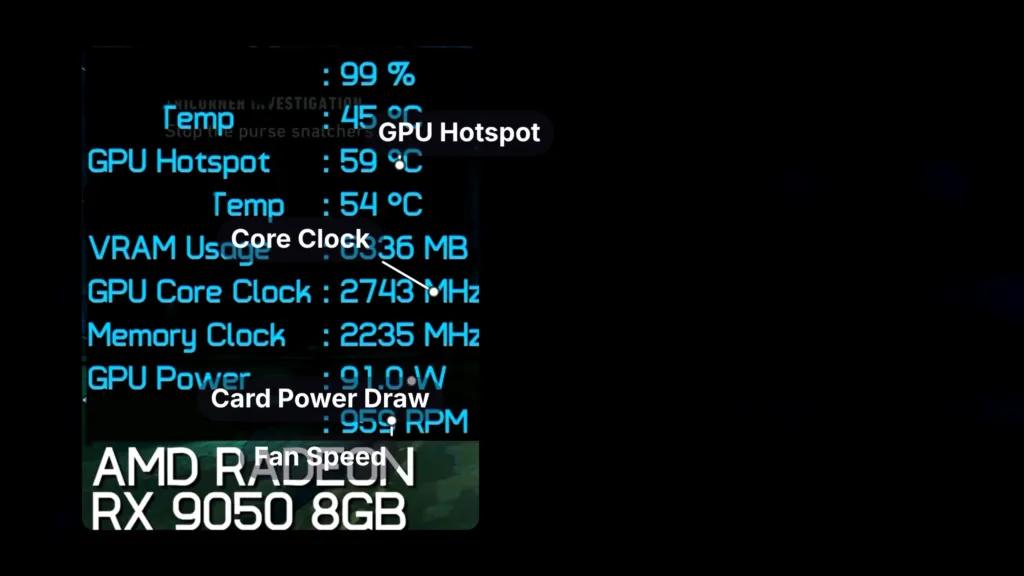
TechSpot’s unnamed sample, run for 30 minutes in a closed ATX case, tells the same story from a completely different card and a completely different reviewer. The hotspot touched 66C before the fans spun up, then settled at 59C once they did, at a barely-there 960 RPM. Memory peaked at just 56C, the card drew around 90W with a 92W ceiling, and the core clock averaged 2,770 MHz across the full half hour. 2 reviewers, 2 different boards, and the same answer: this thing runs cool and quiet without anyone trying to make it look that way.
| Peak GPU hotspot (TechSpot) | 59°C |
| Hotspot before fans engaged | 66°C |
| Fan speed | 960 RPM |
| Memory peak temperature | 56°C |
| Card power draw | around 90W, 92W peak |
| Average core clock | 2,770 MHz |
| GPU temperature (ASRock Challenger, GDM) | 56°C |
| Hotspot (ASRock Challenger, GDM) | 69°C |
| Total board power | 92W |
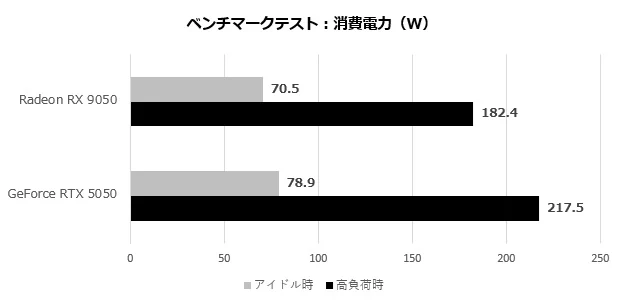
TechSpot put the whole system at about 180W, roughly 80W under what an Arc B580 or RTX 4060 Ti build pulls doing the same job. The catch is the 92W figure itself: a card drawing 75W or less can run straight off the PCIe slot with no extra cable, and the RX 9050 still needs an external 8-pin despite how little it draws.
Pros
- Small enough to disappear into a small-form-factor build
- A light board that doesn’t sag and needs no support bracket
- Runs happily on a 450W power supply with no PSU upgrade required
Cons
- Still needs an external 8-pin PCIe connector despite the low draw
- Sipping 92W matters a lot less when the card is 20% slower than the RTX 5050 at 1080p – efficiency per frame is the measure that counts, and that one doesn’t go AMD’s way
Losses to the RX 7600 and RX 6600
A brand-new RDNA 4 card is supposed to beat the cards it replaced, and in four of TechSpot’s games it doesn’t come close. At 1080p the RX 7600, a card 2 generations older, finished 36% faster in Hogwarts Legacy, 41% ahead in Starfield, 27% ahead in Stalker 2 and 25% faster in Space Marine 2. Those aren’t margins you explain away with driver maturity or a bad settings pass – they’re the kind of gap that normally separates 2 different tiers of card, except here the newer one is on the losing end.
How far ahead the RX 7600 finished at 1080p
The RX 9050 does have a handful of answers. It edged the RX 7600 by 2% in Spider-Man Remastered at 1080p and matched it frame for frame in Marvel Rivals at 1440p, and in Clair Obscur at 1440p it leapfrogged both the RX 7600 and the RX 6600 outright – though at 1440p that’s a fight over frame rates nobody would actually play at. The Spider-Man win doesn’t survive the jump to 1440p either: there, the RX 7600 takes a 15% lead back.
The RX 6600 is older still, which makes the comparison worse in principle even where the scoreboard looks closer. At 1440p in A Plague Tale: Requiem the RX 9050 flat-out trails it, and in Hogwarts Legacy the two cards simply tie at both resolutions. Jedi: Survivor at 1440p goes to the RX 9050, but by only 6%. The one number the new card can point to is 1% lows in Plague Tale – 28 FPS against the RX 6600’s 26 FPS – which at least says the stutter is a touch better even while the average frame rate is behind.
| Game and resolution | Result for the RX 9050 |
|---|---|
| Hogwarts Legacy 1080p | RX 7600 36% faster |
| Starfield 1080p | RX 7600 41% ahead |
| Stalker 2 1080p | RX 7600 27% ahead |
| Space Marine 2 1080p | RX 7600 25% faster |
| Spider-Man Remastered 1080p | RX 9050 2% ahead of RX 7600 |
| Spider-Man Remastered 1440p | RX 7600 15% faster |
| Marvel Rivals 1440p | Matched the RX 7600 |
| Clair Obscur 1440p | Beat both RX 6600 and RX 7600 |
| A Plague Tale: Requiem 1440p | Trailed the RX 6600 |
| Hogwarts Legacy 1080p and 1440p | Tied the RX 6600 |
| Jedi: Survivor 1440p | 6% ahead of the RX 6600 |
Hardware Unboxed’s 10-game data lines up with the same story and widens the list of cards doing the embarrassing. At 1080p, the RX 9050 landed roughly 22% behind the RX 7600 and also finished behind the RX 6650 XT – one more older Radeon the new card can’t get past.
People watching these numbers landed on the exact thing the reviewers did: a card launched in 2025 sitting below hardware AMD itself sold years earlier, and a company that didn’t even bother sending out review samples for it.
The fact it’s slower than a 3060 is insane
I’m surprised how amd never misses an opportunity to miss an opportunity
The Next Rung Up: RX 9060 XT
There’s a cheaper way to see what $280 gets you wrong: look at what AMD’s own next card does on the exact same test bench. TechSpot put the RX 9060 XT 8GB through the same 10-game suite and it averaged 86 FPS at 1080p against the RX 9050’s 49 FPS, a 76% jump. At 1440p the gap barely narrows – 53 FPS against 33 FPS, a 61% uplift – which means the step up isn’t a smoother version of the same card, it’s a different class of product wearing a similar name.
10-game average: RX 9050 8GB vs RX 9060 XT 8GB
Game by game, the gulf gets uncomfortable fast. In A Plague Tale: Requiem the 9060 XT hit 99 FPS at 1080p, 87% ahead of the RX 9050, and at 1440p that stretches to 116% faster. Hogwarts Legacy runs the same pattern: 105 FPS at 1080p for an 88% lead, 95% faster at 1440p. Star Wars Jedi: Survivor and Marvel’s Spider-Man Remastered both land in the mid-70s percent at 1080p, 99 FPS and 182 FPS respectively. Every one of those numbers comes off the same TechSpot bench running the same games – this isn’t a different reviewer’s methodology producing a flattering result, it’s AMD’s own current-generation lineup pulling apart from itself.
| Game | Resolution | RX 9060 XT 8GB | Uplift over RX 9050 |
|---|---|---|---|
| A Plague Tale: Requiem | 1080p | 99 fps | +87% |
| A Plague Tale: Requiem | 1440p | 69 fps | +116% |
| Hogwarts Legacy | 1080p | 105 fps | +88% |
| Hogwarts Legacy | 1440p | 84 fps | +95% |
| Star Wars Jedi: Survivor | 1080p | 99 fps | +74% |
| Marvel’s Spider-Man Remastered | 1080p | 182 fps | +75% |
The hardware explains the scoreboard without needing anything else. The RX 9060 XT runs 2,048 cores to the RX 9050’s 1,024, boosts to 3130 MHz against 2600 MHz, and pushes 20 Gbps GDDR6 for 320 GB/s of bandwidth where the RX 9050 is stuck at 18 Gbps and 288 GB/s. Double the cores, a higher clock and more bandwidth off the same Navi 44 silicon is exactly the kind of stack where the frame rates above stop being a surprise.
| RX 9060 XT core config | 2048 / 128 / 64 |
| RX 9060 XT boost clock | 3130 MHz |
| RX 9060 XT memory | 20 Gbps GDDR6, 128-bit, 320 GB/s |
| RX 9060 XT total board power | 150W |
8GB Still Isn’t Enough
Don’t assume the extra horsepower buys its way past the VRAM wall – it doesn’t. In Stalker 2 at 1440p, where TechSpot found nearly every 8GB or smaller card collapsing, the RX 9060 XT 8GB fell to 9 FPS, barely different from the RX 9050’s 8 FPS. The 16GB RX 9060 XT, tested in the same scene, managed 42 FPS. The extra cores and bandwidth count for nothing once the frame buffer runs out – only the larger memory pool got this test through.
None of that comes free. AMD launched the RX 9060 XT at a $300 MSRP, and the 8GB model now sells for $400 – $120 more than the RX 9050’s $280. Even at that price TechSpot still measured it as roughly 20% better value per frame, which is the uncomfortable math for anyone holding exactly $280: the card in front of them is the worse buy, not the cheaper option it looks like. TechSpot’s advice is to save the extra money and go for the RX 9060 XT, the 16GB version if it’s within reach.
Cost Per Frame Against the Competition
AMD set the RX 9050 at $280, and the RTX 5050 was supposed to undercut it – technical.city lists the GeForce card’s MSRP at $249, and TechSpot rounds it to $250. Neither figure means anything once you try to buy one. Club386 quotes the RTX 5050 at $289, Wccftech and PCMag both put it at $300, and TechSpot found it selling for $320. The RX 9050’s $280 only reads as the cheaper option against the bottom of that range; against TechSpot’s own $320 figure, it’s the GeForce that costs more, not less.
| Card | MSRP | Street price quoted |
|---|---|---|
| AMD Radeon RX 9050 8GB | $280 | $280 MSRP used for comparison |
| NVIDIA GeForce RTX 5050 | $249 / $250 | $289 (Club386), $300 (Wccftech, PCMag), $320 (TechSpot) |
| NVIDIA GeForce RTX 5060 | $300 | $460 (TechSpot) |
| Intel Arc B580 | — | $310 (TechSpot) |
| AMD Radeon RX 9060 XT 8GB | $300 | $400 (TechSpot) |
TechSpot does the math on the whole mess and lands on roughly $40 separating the two cards at retail. That’s not a gap worth defending: TechSpot had already written the RTX 5050 off as e-waste in its own review of that card, and the RX 9050 comes in slower and worse value than the GPU TechSpot just called junk.
The RTX 5060 launched at $300 and now sells for $460, TechSpot says – a card most reviewers treat as a bad buy in its own right. Lined up against that, the $280 RX 9050 only roughly matches it on cost per frame, which is the RTX 5060 being bad enough to reach rather than the RX 9050 being good.
Street pricing of the entry-level field
Intel’s Arc B580 sells for $310, TechSpot reports, and it carries 12GB of VRAM against the RX 9050’s 8GB. It also runs 27% faster, TechSpot measured, and still ends up more than 10% better on value per frame. There’s no angle in that comparison where the Radeon wins.
TechSpot puts a hard number on where this card would stop being a joke: $200, and not a dollar above it. Hardware Unboxed lands in the same spot, saying the price needs to drop closer to $200 before the card makes sense. The risk runs the other way too, since every one of TechSpot’s figures uses the $280 MSRP – a street price of $300 or more makes the whole picture worse, not better.
Club386 ran the numbers from a different angle and found that spending $10 more buys an RTX 5050 and far greater value per dollar. GameGPU calls the launch price inflated outright and says the card’s long-term prospects depend on retail prices dropping fast, because right now, GameGPU says, the price is too high for what the card actually does.
Japan is where the RX 9050 actually reached shelves, and the listing there tells its own story. The ASRock Radeon RX 9050 Challenger 8GB OC went up at 55,303 yen, which GameGPU logs as a $348 street price against a $279 recommended one. Japanese buyers spotted the obvious problem: the RX 9060 XT sells for roughly that same money, so anyone paying $348 for this card is paying what the next card up costs.
None of this is happening in isolation. Akihabara retailers report graphics card prices up 20% to 30% across every grade right now, purchase limits have gotten more severe, and an ongoing memory shortage has pushed pricing up across the board. TweakTown notes entry-level GPUs in general have had a rough stretch lately. That explains why the RX 9050 landed at $279 instead of something lower – it doesn’t excuse it.
- Buy second-hand instead, TechSpot advises, rather than anything new at this end of the market
- Pick up Intel’s Arc B580, which both TechSpot and Hardware Unboxed point to as the stronger option at around $310
- Save for AMD’s own RX 9060 XT, ideally the 16GB version, if the budget stretches that far
- The RX 9060 XT 8GB costs $400 – $120 more than the RX 9050 – and still comes out around 20% better on value
Buyers watching this unfold have already worked out their own number, and it’s lower than anything a reviewer printed.
If this card sold for 149.99 it would a great budget GPU, but not for 279.99, that’s just ridiculous.
Another commenter gets to the same place with a slightly different figure.
For 160-170$ this would be a nice entry level offering but I guess it won’t be priced that low
A Launch With No Review Samples
AMD put the RX 9050 up for sale on 28 July without any noise around it, and it sent no review samples to anyone – not to the usual reviewers, not to anyone else. AMD went a step further and blocked its own board partners from shipping cards out too, so there was no side door for a reviewer to walk through. For several days after launch, nobody anywhere had an RX 9050 on a bench. Hermitage Akihabara, known as GDM, was the first to break that silence.
- AMD sent no review samples to anyone
- AMD’s board partners were blocked from shipping cards out to reviewers
- TechSpot sourced a card through side-channel contacts instead of going through AMD
- TechSpot can’t name the partner who supplied it or show the card on camera
- The source asked to stay anonymous, according to Hardware Unboxed
AMD didn’t go silent on performance entirely – it posted its own frame rates for the RX 9050 right on the product page. What it left out is the part that would have let anyone judge them: no RTX 5050 next to those numbers, no older Radeon, nothing to measure the card against. A frame rate with no comparison point is easy to publish and impossible to argue with, which is exactly the kind of number a company puts out when it isn’t handing reviewers a card to check it against anything else.
Once independent numbers did land, buyers didn’t read the missing samples as an oversight. At $279, a card that AMD wouldn’t let anyone test before launch looked, to the people shopping for it, like a company that already knew what those tests would show.
A product designed to scam people who will buy the cheapest option with the word ‘gaming’ attached to it.

The 4GB Card Hiding Behind the Same Name
There’s a second RX 9050 nobody has benchmarked yet, and it’s worse than the one covered here. AMD has confirmed a 4GB version will ship inside at least one prebuilt PC, sold OEM-only under the identical RX 9050 name – with half the VRAM and half the memory bandwidth of the 8GB card. TechSpot says it still plans to track one down and put it on a bench.
Technical.city’s Aggregate Score
Technical.city runs no benchmarks of its own – it aggregates other people’s numbers into a single score, and by that measure the gap looks worse than anything GDM or TechSpot measured firsthand: the RX 9050 lands at 24.40 against the RTX 5050’s 40.03, a 64% lead for the GeForce. The site’s own recommendation follows the score – it picks the RTX 5050 as the card to buy.
Technical.city aggregate performance score
That 64% figure traces back to Passmark, and Passmark’s RX 9050 number rests on just 4 submitted samples against 2,996 for the RTX 5050 – a dataset too thin to carry a headline percentage. Technical.city doesn’t even list a cost-effectiveness rating for the Radeon, leaving the value case blank where the GeForce gets a number.
Thin Data Behind a Big Number
4 samples built the RX 9050’s Passmark score of 10208, next to nearly 3,000 behind the RTX 5050’s figure. Treat the 64% gap as a database artifact until more results come in, and note that technical.city still has no cost-effectiveness rating for the Radeon at all.
Where the Hardware Actually Differs
Lay the two side by side and the RTX 5050 wins almost every column that matters: 2,560 CUDA cores against the Radeon’s 1024, a texture fill rate of 205.8 against 166.4, and 20 ray tracing cores against 16. The one spec where the RX 9050 leads is ROPs, 64 against 32, and it doesn’t show up anywhere in the frame rate numbers. Memory bandwidth tells the same story at a smaller scale: 320.0 GB/s on the GeForce against 288.0 GB/s on the Radeon.
| Specification | Radeon RX 9050 | GeForce RTX 5050 |
|---|---|---|
| Pipelines / CUDA cores | 1024 | 2560 |
| Boost clock speed | 2600 MHz | 2572 MHz |
| ROPs | 64 | 32 |
| TMUs | 64 | 80 |
| Texture fill rate | 166.4 | 205.8 |
| Ray Tracing Cores | 16 | 20 |
| Tensor Cores | no data | 80 |
| Manufacturing process | 4 nm | 5 nm |
| Power consumption (TDP) | 92 Watt | 130 Watt |
| Power efficiency | 20.66 | 23.98 |
| Memory bandwidth | 288.0 GB/s | 320.0 GB/s |
| Cache | 32 MB L3 / 4 MB L2 | 24 MB L2 |
| Interface | PCIe 5.0 x16 | PCIe 5.0 x8 |
| DLSS | – | + |
| CUDA | – | 12.0 |
- The RX 9050 draws 92W on a 4nm process, well under the RTX 5050’s 130W on 5nm – yet technical.city still rates the Radeon’s power efficiency at 20.66 against 23.98 for the GeForce.
- The Radeon carries a bigger cache, 32MB L3 plus 4MB L2 against the GeForce’s 24MB L2.
- The RX 9050 runs a wider PCIe 5.0 x16 link against the RTX 5050’s PCIe 5.0 x8.
- The Radeon has no DLSS support and no CUDA at all.
Fortnite Frame Rate Approximations
These aren’t bench runs – technical.city labels them as its own approximations, modelled rather than measured. At ultra settings and 1080p that puts the RX 9050 at 90-95 FPS against 140-150 for the RTX 5050. The gap doesn’t shrink as resolution climbs: at 1440p it’s 60-65 against 100-110, and at 4K it’s 27-30 against 55-60, which puts the GeForce at roughly double the Radeon’s frame rate by the time you’re at 4K.
| Fortnite setting | Radeon RX 9050 | GeForce RTX 5050 |
|---|---|---|
| ultra / 1080p | 90−95 | 140−150 |
| QHD / 1440p | 60−65 | 100−110 |
| 4K / 2160p | 27−30 | 55−60 |
User sentiment matches the recommendation: the RX 9050 holds a 3.2 rating from just 16 votes, against 3.8 from 2,317 votes for the RTX 5050, and technical.city’s own pick for the segment is the RTX 5050.
The Spread Between Reviewers
Pick 5 reviewers and you get five different numbers, but they don’t scatter randomly – they bunch. Tom’s Hardware clocked the RX 9050 at roughly 30% slower in games. Wccftech landed on 20% to 30% across most of what it tested. Club386 put the ceiling at 27% behind. Hardware Busters split its own results in two: close to 30% in games once DOOM is pulled out of the average, and a tighter 18% gap in 3DMark alone. 4 reviewers, 4 separate test benches, and the overlap sits in a band a buyer can actually plan around: call it 20% to 30% slower, depending on what you’re running.
| Reviewer | Quoted RX 9050 deficit vs RTX 5050 |
|---|---|
| Tom’s Hardware | roughly 30% slower in games |
| Wccftech | 20-30% lower performance |
| Club386 | up to 27% slower |
| Hardware Busters | 18% in 3DMark, around 30% in games |
| PCMag | 10-25% in synthetic benchmarks |
| TechSpot | RTX 5050 20% faster at 1080p, tied at 1440p |
| Technical.city | RTX 5050 64% faster on aggregate score |
Technical.city’s 64% doesn’t belong in that band, and it’s worth saying why. It isn’t a game anyone ran – it’s an aggregate score, 24.40 against 40.03, built from only 4 Passmark samples of the RX 9050. PCMag ran actual synthetic benchmarks and came back with a 10% to 25% gap, which sits close to everything else on this list. One number comes from testing hardware. The other comes from averaging whatever a handful of strangers happened to upload, and it shows.
Push the resolution up and the gap looks like it’s closing, which is the wrong read. TechSpot had the RX 9050 at 49 FPS at 1080p across its 10-game suite, and by 1440p both cards had fallen to 33 FPS – a dead heat. Hardware Busters found the same pattern in Rainbow Six Siege at 4K Ultra+, where both cards tied at 64 FPS. That’s not the Radeon catching up; it’s 8GB of VRAM running out on both cards at once. Stalker 2 at 1440p dropped the RX 9050 to 8 FPS, and the RTX 5050, RX 7600 and RX 6600 all collapsed there too. Buy either of these cards and 1440p isn’t really on the table.
Pros
- Pulls about 35W less than the RTX 5050 under load, and about 8W less at idle
- A 450W power supply covers it, according to GameGPU
- Runs cool: the ASRock Challenger held 56C with a 69C hotspot, and TechSpot measured a 59C hotspot drawing just 92W of board power
- Tom’s Hardware says it comfortably handles 1080p gaming
Cons
- Loses every performance benchmark reviewers ran, by margins ranging from 18% to 64% depending on the test
- Hardware Busters calls a card that trails by 18% to 30% and wins only on watts a hard sell
Total system power under load
How Thin This Evidence Actually Is
Most of the numbers behind every one of these percentages trace back to one Japanese reviewer, GDM, which Tom’s Hardware flagged as preliminary results from a single reviewer rather than a settled verdict. AMD sent no review samples to anyone and blocked its own board partners from shipping cards out, so TechSpot had to source a unit through side channels and still can’t say which RX 9050 model it tested. On top of that, the card only sells in Latin America, Asia-Pacific and Japan, with Australia and Korea excluded even there. A reader in most of the world is reading reviews of a card nobody will sell them.
Two things are still open. The 4GB OEM-only version of the RX 9050 has half the VRAM and half the bandwidth of the card every one of these reviewers tested, and nobody has put it on a bench yet – PCMag is already predicting a damning verdict once somebody does. AMD hasn’t given North America or Europe a release date either, and keeping the 8GB card off Western shelves while it only sells in Latin America, Asia-Pacific and Japan stops looking like a shipping delay the longer it drags on. None of this happens in a healthy market, either: TweakTown has flagged entry-level GPUs as rough across the board right now, with pricing creeping up everywhere because of the memory shortage.