

Key Takeaways
- 13DHP lifts fin utilization from 70% to 95% versus a conventional dual-tower layout, per Tom’s Hardware, which is the real engineering claim behind the single-tower-does-dual-tower-work pitch.
- 2Buy the SKU that matches your socket. TweakTown found the Intel-tuned V8 running hotter (67.1°C) on an AMD socket than the AMD-tuned version (66.7°C) on the same chip.
- 3At 167.3mm tall, this cooler won’t fit Cooler Master’s own Elite 481 Wood, which caps at 160mm clearance. Check your case before you check the specs.
- 4Keep the front fan under 70-80% PWM. Hardware Busters found noise climbs sharply past that point, while 25-30 dBA already captures most of the cooling on offer.
- 5At $119.99-$120, this costs roughly three times the Thermalright Peerless Assassin 120 SE, which PC Gamer found matches or beats it on their bench, minus the quieter running.
- 6Inside the flagship tier rather than against budget coolers, Hardware Busters has it beating the Noctua NH-D15 G2 HBC and edging the PCCooler RZ820 Display on performance-per-price.
Six Heatpipes, Two of Them Different: The 3DHP Layout
A standard heatpipe is a U with two ends: heat goes in one side, comes out the other, and that’s it. 3DHP starts from that same U and welds a third leg into the middle of it, so from above it reads like a trident instead of a bent tube. That middle leg isn’t a bend, it’s a T-style junction, which means the pipe now has more than two ends pulling heat away from the die at once.
Every dual-tower cooler has a dead zone: the fins in the middle of the stack, furthest from either heatpipe run, sit noticeably cooler than the rest because nothing is pushing heat into them. Tom’s Hardware reported that Cooler Master rates fin utilization at 70% on a conventional design and 95% with 3DHP, which is another way of saying that cool patch mostly disappears. Back2Gaming backs that with a heat extraction figure over 50% higher at the hotspot and a thermal camera clip showing heat actually reaching those center fins under a 250W load. The reason this matters is the claim riding on top of it: a single-tower cooler that closes the gap on dual-tower designs, because the fins a dual-tower would need for extra surface area are finally doing real work on one tower instead.
None of that is a free lunch. A heatpipe wall runs 0.3 to 0.4 mm thick, and welding a third leg into that wall without opening a leak or collapsing the vapor chamber is a manufacturing problem, not a design sketch. Cooler Master says it holds the patent on the T-joint itself along with the mass production process needed to seal it consistently, which is the part that decides whether 3DHP ships as a novelty on one flagship cooler or becomes the new normal across a lineup.
Two Different Coolers, Not One With Two Brackets
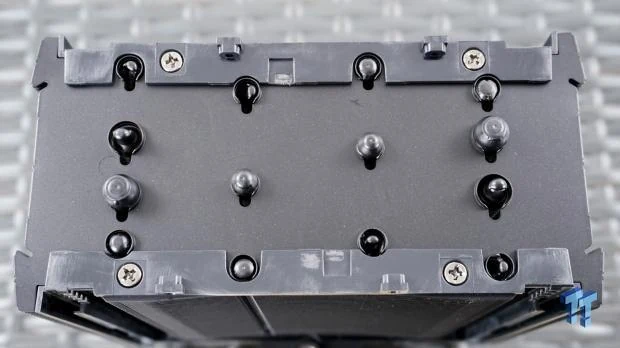
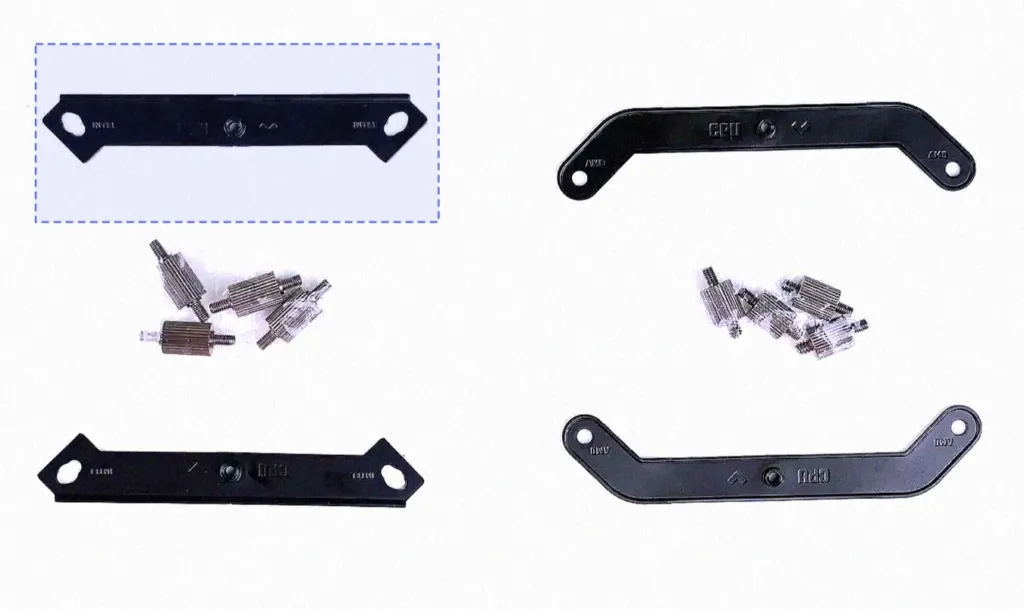
Cooler Master lists this as two SKUs, Intel and AMD, and that split isn’t a box-stuffing exercise. Each version ships with mounting hardware for the other platform too, so you can physically bolt either one to either socket. What you can’t do is swap the tuning that made it into the metal before it left the factory.
Lay the two base plates next to each other and the difference is visible without a straightedge. The AMD version sits flat, the Intel version bulges outward toward the center. TweakTown confirms the pairing directly: convex on Intel, flat on AMD. PC Gamer describes the Intel plate as reading more concave, which is the same surface looked at from the other side of the same observation.
That shape isn’t decoration. Intel chips bow slightly once socket load is applied, leaving a small gap in the center of the IHS that a flat plate would never fully close. The convex Intel base is built to push into that gap and keep contact where the die is actually hottest, which is why Cooler Master calls out higher sustained heat density as the design target there. AMD’s IHS doesn’t bow the same way, so the flat plate on that version is chasing something simpler: even contact across a surface that’s already flat, rather than compensating for one that isn’t.
The tuning goes deeper than the plate. Back2Gaming reports each 3DHP pipe on the Intel version is rated for a 90W Q-Max, against 70W on the AMD version, a real gap in how much heat a single pipe is set up to move before it stops being efficient. The internal liquid volumes differ between the two versions as well, which is the kind of change you can’t see from outside the cooler and can’t retrofit by swapping a bracket.
| Feature | Intel version | AMD version |
|---|---|---|
| Base plate shape | More convex | Flatter |
| 3DHP Q-Max | 90W per pipe | 70W per pipe |
| Primary design target | Higher sustained heat density | Contact consistency |
| Supported sockets | LGA 1851 / 1700 / 1200 / 115x | AM5 / AM4 |
Buy the version for your CPU, not whichever is in stock
None of this is theoretical. Testing showed that running the wrong version on a platform reduces performance and produces thermal spikes, the base plate and Q-Max tuning working against the chip instead of for it. On top of that, the Intel unit is physically harder to start on an AMD board, the spring-loaded screws taking more force to seat than they should. Buy the SKU that matches your socket.
Size, Weight and the Full Spec Sheet
Nobody agrees on how much this thing weighs. Windows Central put it at 2.57 lbs, or 1.17 kg, PC Gamer measured 1068 grams, and Back2Gaming logged a net weight of 1334 grams, a spread of over 260 grams between the lightest and heaviest number on record. That’s not a rounding quirk, it’s three different scales telling three different stories, and it matters because a cooler in this weight class is putting real sustained load on a motherboard’s socket and standoffs for years. We’re listing all three rather than picking a favorite, because none of them has a claim to be the real number.
| Dimensions | 138.95 x 136.47 x 167.3 mm |
| Weight (reported) | 2.57 lbs (1.17 kg) — Windows Central; 1068 g — PC Gamer; 1334 g net — Back2Gaming |
| Socket support | Intel LGA 1851/1700/1200/115x, AMD AM5/AM4 |
| Front fan airflow | 89.6 CFM |
| Front fan pressure | 3.85 mmH2O |
| Front fan max RPM | 2500 |
| Rear fan airflow | 61.0 CFM |
| Rear fan pressure | 2.00 mmH2O |
| Rear fan max RPM | 2050 |
| Fan dimensions | 120 x 120 x 30 mm |
| Front fan noise | 37 dB(A) |
| Rear fan noise | 34 dB(A) |
| Warranty | 6 years |
| Official RAM clearance | Up to 45 mm |
| Fan MTTF | >200,000 hours |
| Fan bearing | Loop Dynamic Bearing |
| Fan blade material | Liquid Crystal Polymer (LCP) |
| Rear fan design | Reverse-flow ring-blade |
| Sliding rail system | Adjustable fan height |
| RGB lighting | None |
What’s in the Box
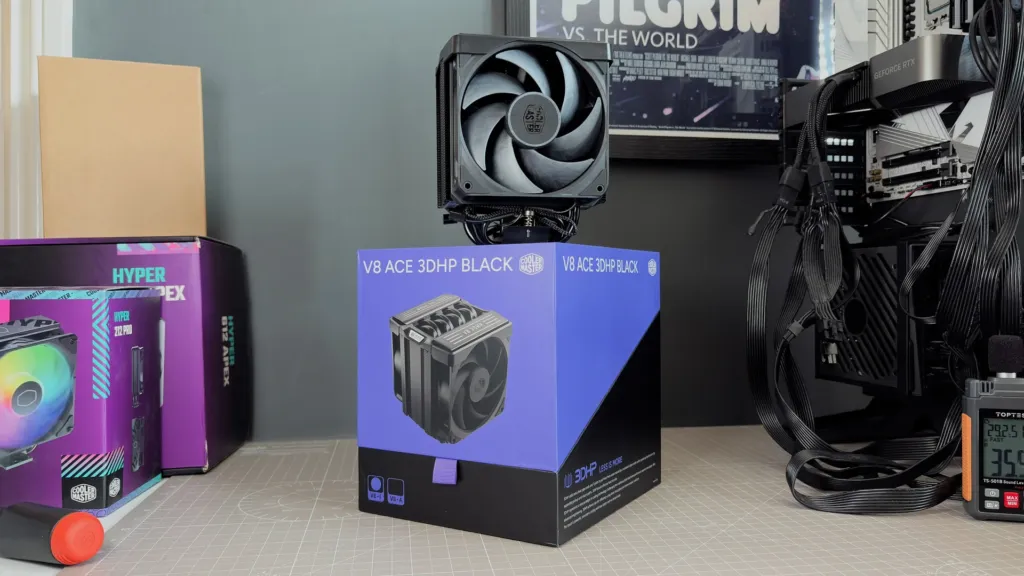
The box opens with a pull tab, and inside the cooler sits in foam rather than loose cardboard dividers, the kind of packaging detail that costs money and tells you where some of that $120 went. In the accessory tray is a tube of Cooler Master’s own CryoFuze thermal paste and a Y-splitter cable to run both fans off one header, so you’re not hunting for a second fan port on the board. What isn’t in there is any RGB header, controller, or lighting of any kind, and on a cooler this size that’s a deliberate omission rather than a missing feature.
AMD Thermal Benchmarks
Power delivery on a flagship chip isn’t where the V8 Ace runs into trouble. Tom’s Hardware put it on a Ryzen 9 9950X3D and had it handling more than 249W at full fan speed, and more than 245W once the fans were noise-normalized down to something you’d actually run day to day. Where Tom’s flagged a weakness was gaming, not sustained thermal load, which is a different failure mode than the one buyers usually worry about when they’re pricing dual towers.
Windows Central ran the cooler on an open test bench with a Ryzen 7 9850X3D holding around 5.2GHz for 15 minutes, and got an average of 81.5°C with a peak of 83.5°C. A 2°C spread between average and peak over a 15-minute stretch is a small window, and it’s the kind of number that says the cooler settled into equilibrium rather than climbing the whole run.
Hardware Busters kept things fixed at 25 dBA and ran a Ryzen 9 7900X at 5172 MHz drawing around 188W, and the V8 Ace held it at 94.8°C, good for third place overall on AMD. Let the fans open up to full speed and the ranking changes: the V8 Ace moves to second, ahead of the Noctua NH-D15 G2 LBC and just behind the PCCooler RZ820 Display. That’s a cooler that’s giving up ground to quieter fixed-noise competitors but taking it back the moment you let it get loud.
TweakTown: Ryzen 9 9900X
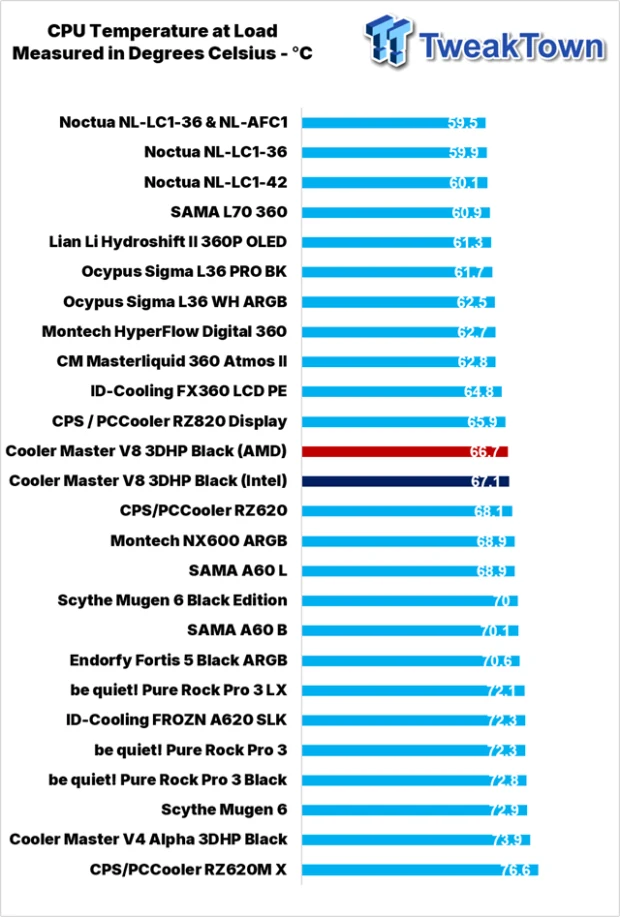
TweakTown’s Ryzen 9 9900X numbers give the AMD-tuned V8 Ace the lowest idle temperature of every air cooler in the test, 40.3°C. Under load it climbed to 66.7°C, second only to the RZ820 Display, and the boost clock averaged 5.220GHz, again second among the air coolers tested. Worth noting: the Intel-tuned V8 bolted to the same AMD socket ran hotter under load at 67.1°C, which is the clearest evidence yet that Cooler Master’s per-platform tuning isn’t a marketing line.
Back2Gaming: Ryzen 9 9950X
Back2Gaming Ryzen 9 9950X full-fan temperatures by power target
Back2Gaming’s power-target sweep on the Ryzen 9 9950X shows the V8 Ace scaling cleanly from 57.3°C at 125W to 73.7°C at 170W to 93.2°C at 225W, but only at full fan speed. Drop to 60% or 30% fan duty at that same 225W target and the chip hits its 95.2°C throttle ceiling, so the headroom above only exists if you’re willing to run the fans loud. Take the power cap off entirely and the gap gets stark: 233.7W sustained at 100% fan versus just 180.9W at 30% fan, a difference that has nothing to do with the heatsink and everything to do with how much air you’re willing to move through it.
PC Gamer on the Core i7-14700K
PC Gamer’s 14700K numbers put the V8 Ace right at the door of the class leader without opening it. In Baldur’s Gate 3 it averaged 47°C, one degree behind the Noctua NH-D15 G2, and in Prime95 at 1.275V it hit 64°C max, tied with the Arctic Freezer 36. Push the voltage to 1.325V and the gap reappears: 76°C max, second only to the NH-D15 G2 again. X264 encoding put it at 53°C average, good enough for a top-three finish. The pattern across four different workloads is consistent: this is a dual-tower-class cooler that trades with the NH-D15 G2 rather than losing to it outright.
Hardware Busters on the Core Ultra 9 285K
On Intel’s flagship 285K, Hardware Busters held about 300W of sustained load at 25 dBA, a noise floor that’s easy to forget the PC is running, and still finished third overall among coolers tested at that setting. Let the fans run at full speed and the V8 Ace produced lower CPU temps than nearly every competitor on the chart. That’s the trade a buyer is actually making here: near-silent operation costs a couple of chart positions, and giving the fans their head buys most of those positions back.
Back2Gaming’s power-capped 285K runs
Back2Gaming capped the 285K at 280W and ran the fans flat out, landing at 90.6°C, 14 degrees below the chip’s thermal junction maximum, which is the kind of headroom that says the cap, not the cooler, was the limiting factor. Take the cap off and the V8 Ace sustained 331.3W at 100% fan, a real ceiling above what most Intel builds will ever throw at it. Drop to 30% fan and that ceiling falls hard, to 228.7W, and the 60% fan setting in between cost 1.5 to 4.8 degrees across the range tested. For anyone chasing quiet, the number to remember is 331.3W at full noise against 228.7W at low noise: that’s the real range the fan curve buys and costs.
OC3D and Windows Central round out the Intel picture
OC3D ran the i5-14600K fixed at 1.27V, and the detailed numbers from later pages of that review weren’t captured here, so treat that data point as a marker rather than a full result. Windows Central’s separate test, run on AMD rather than Intel, found the V8 Ace beating the Thermalright Peerless Assassin 120 SE, a budget dual-tower that a $120 cooler ought to beat if the extra spend is buying anything at all.
Acoustics and 40 dB(A) Results
Five outlets ran their own noise passes on the V8 ACE 3DHP, and the results don’t agree with each other any better than the weight scales did. Hardware Busters clocked full speed at 37.9 dBA, which puts it on the louder end of the flagship class rather than the quiet end, and their testing shows why: noise climbs fast once the fans cross 70-80% PWM. Below that line the cooler behaves; above it, it doesn’t.
Where to actually set the fan curve
Hardware Busters’ data points to a practical fan curve rather than a maxed-out one: 25-30 dBA already captures most of what the cooler can do thermally, so there’s little reason to push past it for a quiet build. The extra decibels beyond that point buy you very little extra cooling.
TweakTown ran both SKUs under load and got 36 dB out of the AMD version against 37 dB for the Intel one. That’s a one-decibel gap, small enough to ignore in practice, but it lines up with Cooler Master tuning each SKU separately rather than shipping identical fan curves under two badges.
PCGamer’s own full-speed number came in at 48 dBA, well above Hardware Busters’ and TweakTown’s figures, which says more about their test conditions than about the cooler itself. What matters is where that number sits against the competition: quieter than the Thermalright Peerless Assassin 120 SE, louder than the Noctua NH-D15 G2. That middle spot is where the V8 ACE 3DHP keeps landing across every test in this section.
Windows Central’s reading is the loudest on record at 55.8 dBA, nearly 18 dBA above Hardware Busters’ 37.9 figure. That gap comes down to an open test bench rather than a case, which does nothing to muffle fan noise the way a closed build would. It’s not a number to hold against the cooler directly, but it does show what the fans sound like with nothing standing between them and the microphone.
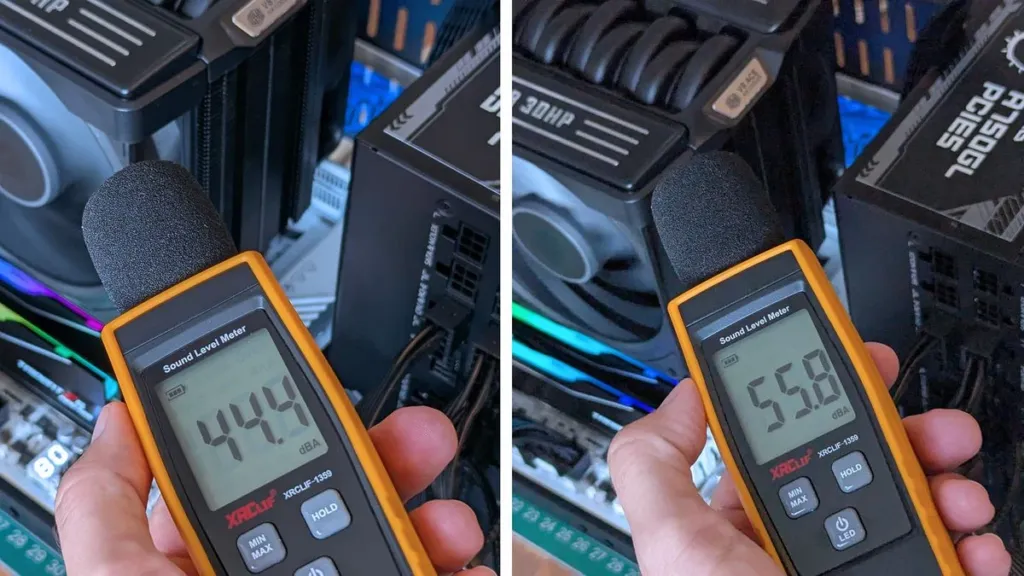
Back2Gaming’s testing points at which fan is actually responsible for the noise: the front intake is audible at max speed while the rear ring-blade fan stays dead silent even then. Their tolerance line sits at 80% duty, which they call tolerable, with 90-100% definitely audible. That matches the fan-curve advice above: keep the front fan out of its top quarter and the cooler stays livable.
The measurements above capture decibels, not motion, but one viewer watching a V8 ACE 3DHP review noticed something the meters don’t log: the cooler itself moving with the airflow.
11:18 the cpu cooler is dancing with the air turbulence LOL
Installation: AMD and Intel Aren’t the Same Job
AMD boards need their stock retention bracket pulled off entirely before the standoffs and mounting bars go on, which is more disassembly than a typical AM5 cooler asks for but not a hard job once you know that’s the sequence. The fans help rather than hurt here: they slide off the rail system cleanly, so you’re not fighting a fully assembled tower to get a screwdriver to the backplate. Intel installs skip that removal step altogether and rely on a backplate built for LGA sockets that does what it needs to without extra fuss.
The front fan sits low enough that it overhangs the DIMM slots, which would be a problem on its own if the rail system didn’t let you slide that fan upward to clear tall memory. Do that and you’re adding roughly 5mm to the cooler’s overall height, on top of the 167.3mm it already occupies. The V8 ACE will fit over RAM either way, but a lower-profile kit means you don’t have to make that trade at all.
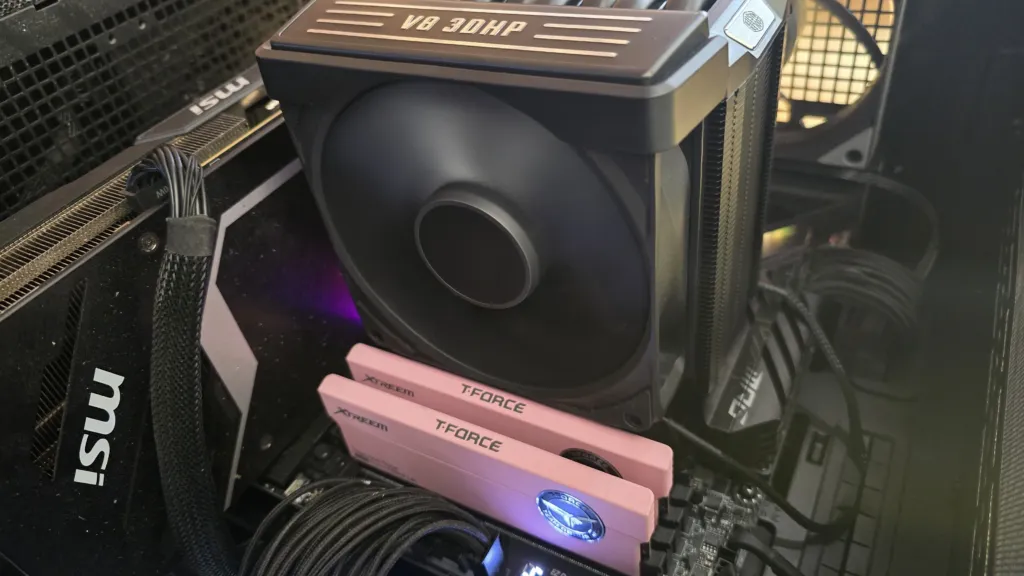
That 167.3mm cooler height rules out plenty of cases before you’ve even opened the box. Cooler Master’s own Elite 481 Wood only supports 160mm of clearance, so the V8 ACE won’t go in it, and any compact case built to similar limits is off the table too.
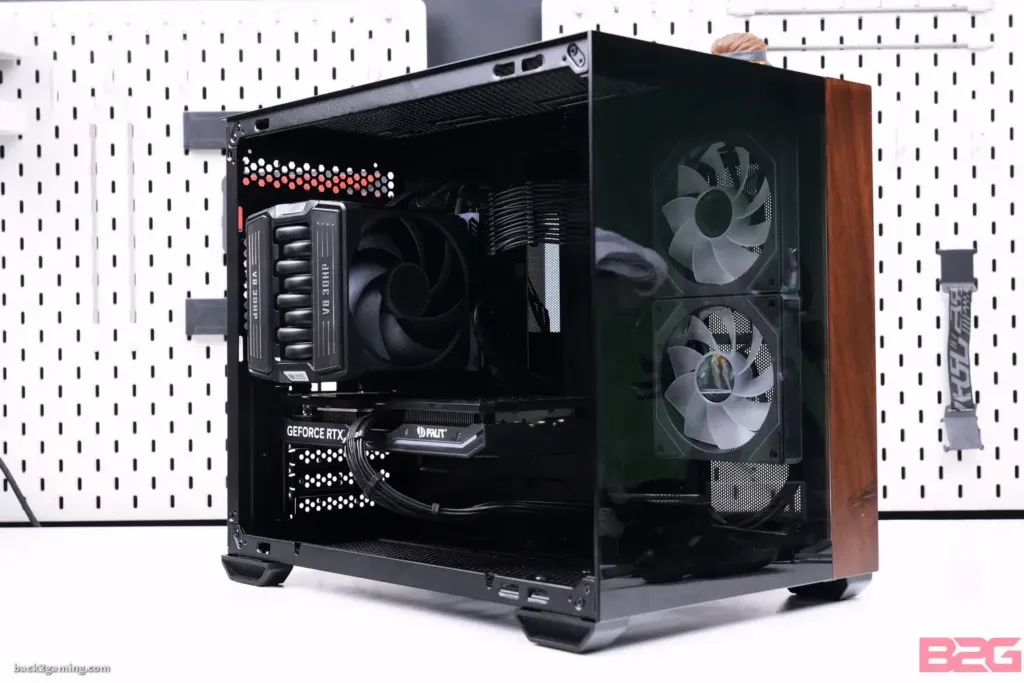
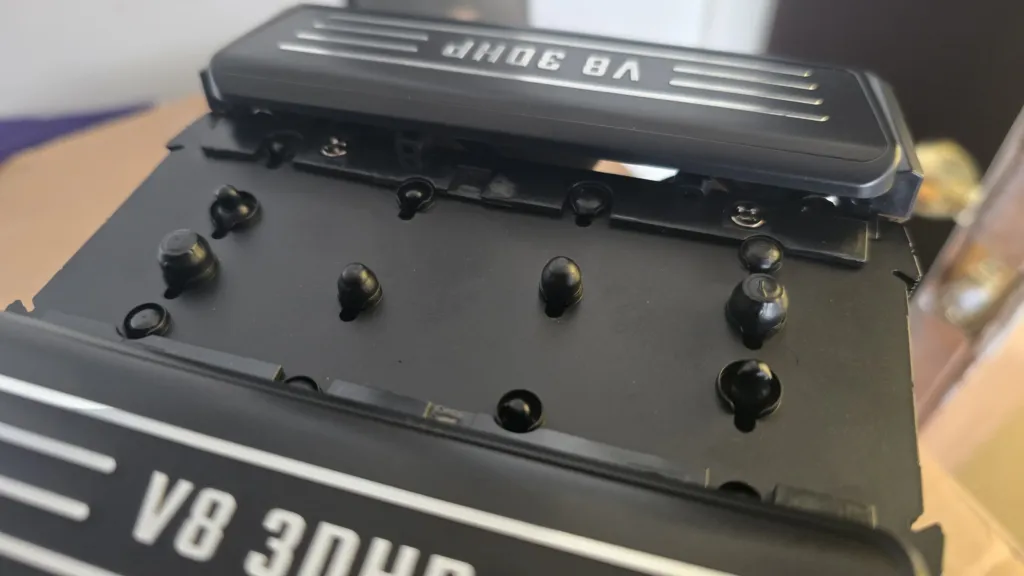
Those same rails that make installation easier cut both ways. The fans pop off with no drama, but their own weight can shift them out of position if you’re not paying attention while handling the tower. They’re held to the sliding frame with regular screws, though, so swapping them for something else later is a normal job rather than a warranty risk.
The materials read as premium wherever you look: a black fin stack, metal trim on top, a nickel-plated copper base underneath. Where it falls down is documentation, not hardware, the mounting parts aren’t clearly labeled and the fan splitter could stand to be marked better than it is. There’s no RGB anywhere on this cooler.
Value and the Competition: What $120 Buys Against the Field
Every major outlet agrees on the number that matters least, which is the sticker. Tom’s Hardware, Windows Central, and Back2Gaming all list the V8 Ace at $119.99, TweakTown puts it a nickel lower at $119.95, and PC Gamer rounds it to $120, or £110 across the pond. Tom’s Hardware calls that a premium price tag, and at this point in the review the number isn’t in dispute, only what it buys you.
The counterargument sits one shelf down. PC Gamer found the Thermalright Peerless Assassin 120 SE, at $40 or less, matches or betters the V8 Ace on their bench, and the only thing the Peerless Assassin gives up to get there is noise, since PC Gamer clocked it as louder. For a build that isn’t going to be judged on a decibel meter, that’s most of the V8 Ace’s thermal case gone for a third of the money.
Hardware Busters draws the line where it should be drawn: value is not the V8 Ace’s primary strength, and budget coolers deliver better performance per euro across the board. But inside the flagship tier the comparison flips. Hardware Busters has the V8 Ace beating the Noctua NH-D15 G2 HBC on performance-per-price, and coming in slightly ahead of the PCCooler RZ820 Display on the same measure. It’s not a budget pick, it’s a cheaper way into a category where the alternatives cost more for less.
TweakTown puts the RZ820 Display’s street price at $90 to $130, a range that overlaps the V8 Ace almost entirely, and argues the V8 Ace’s price is justified by its lower noise. When two coolers land in the same money and one of them runs quieter, that’s the tiebreaker doing the actual work, not the spec sheet.
Not a Value Pick
Hardware Busters is blunt about it: value is not the V8 Ace’s primary strength, and budget coolers deliver better performance per euro. Anyone shopping strictly on that ratio should stop reading here and buy the cheaper cooler.
The rest of the field mostly agrees on where the V8 Ace sits rather than what it’s worth. Windows Central calls it niche, since plenty of builders will just settle for a cheaper cooler and call it done. Back2Gaming prices it at PHP 7,990, which lands below the dual-tower flagships and above the budget towers in that market. OC3D frames it plainly as a shot at the NH-D15 G2 at a lower price, and Windowsforum’s summary is the closest thing to a verdict here: the $120 is for builders paying for the engineering, not for the number on the box.
Community members react to V8 Ace and air cooling choices
Not everyone in the comments is satisfied with 138.95 mm of height and a dual-tower footprint. One viewer wants Cooler Master to go bigger, all the way to the clearance modern cases actually offer.
I would really like to see CM release a large air cooler that can actually occupy that 220mm of CPU clearance.
Another commenter isn’t asking for more metal, just a different name on it.
cooler master x noctua would be a dream
And a third comment is exactly the kind of question this section is meant to answer, aimed at a very different build.
For a 9800x3d 5070 ti b850 tomahawk what case do i choose and should i go with air cooling or liquid. Mostly used for warzone cod gaming ?