
Key Takeaways
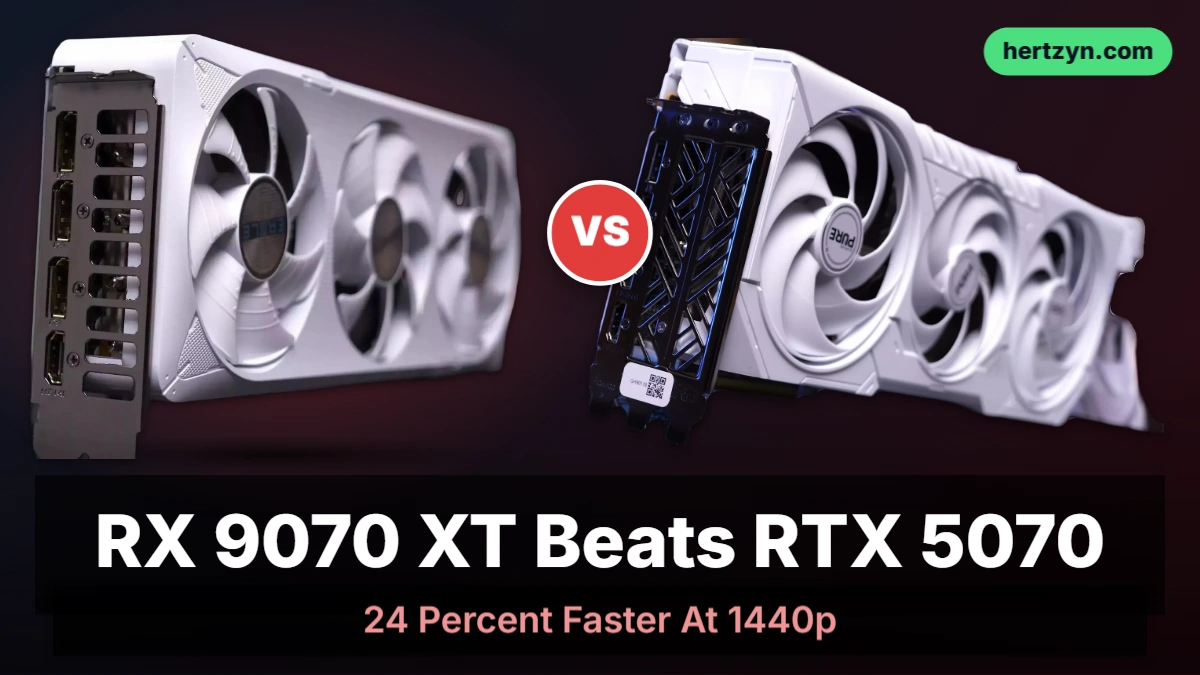
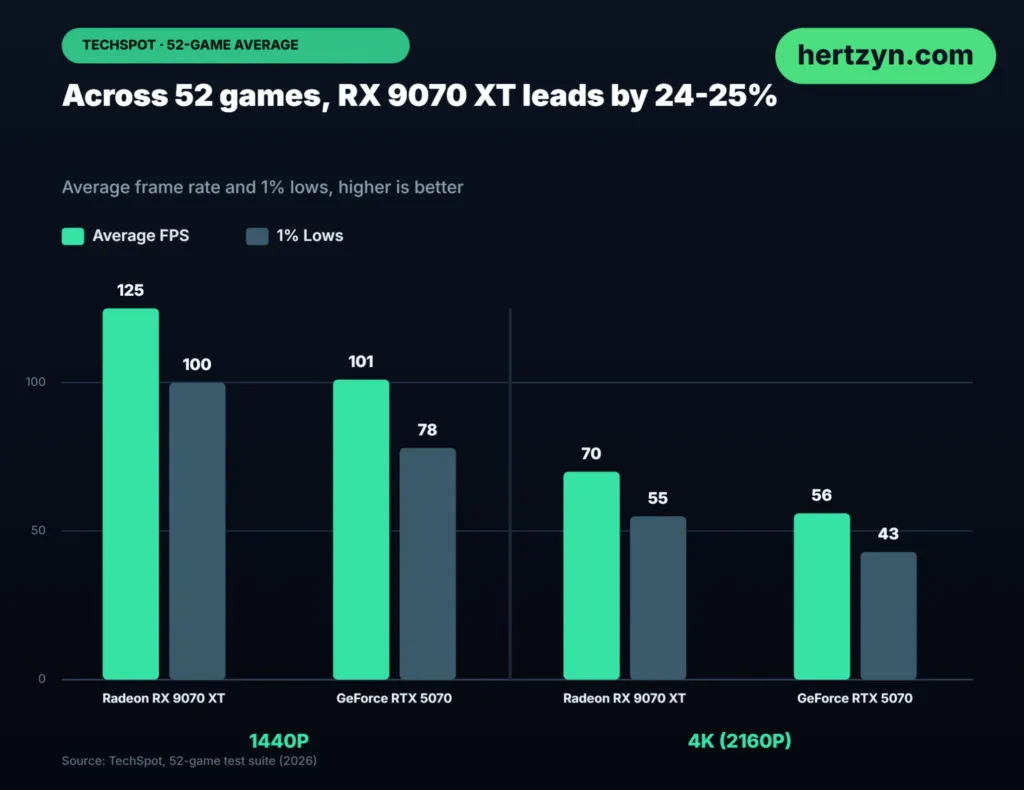
- 1For rasterized 1440p gaming, the RX 9070 XT is the pick: TechSpot measured it 24 percent faster across 52 games, and Newegg’s own testing puts the gap at 7 to 17 percent depending on title.
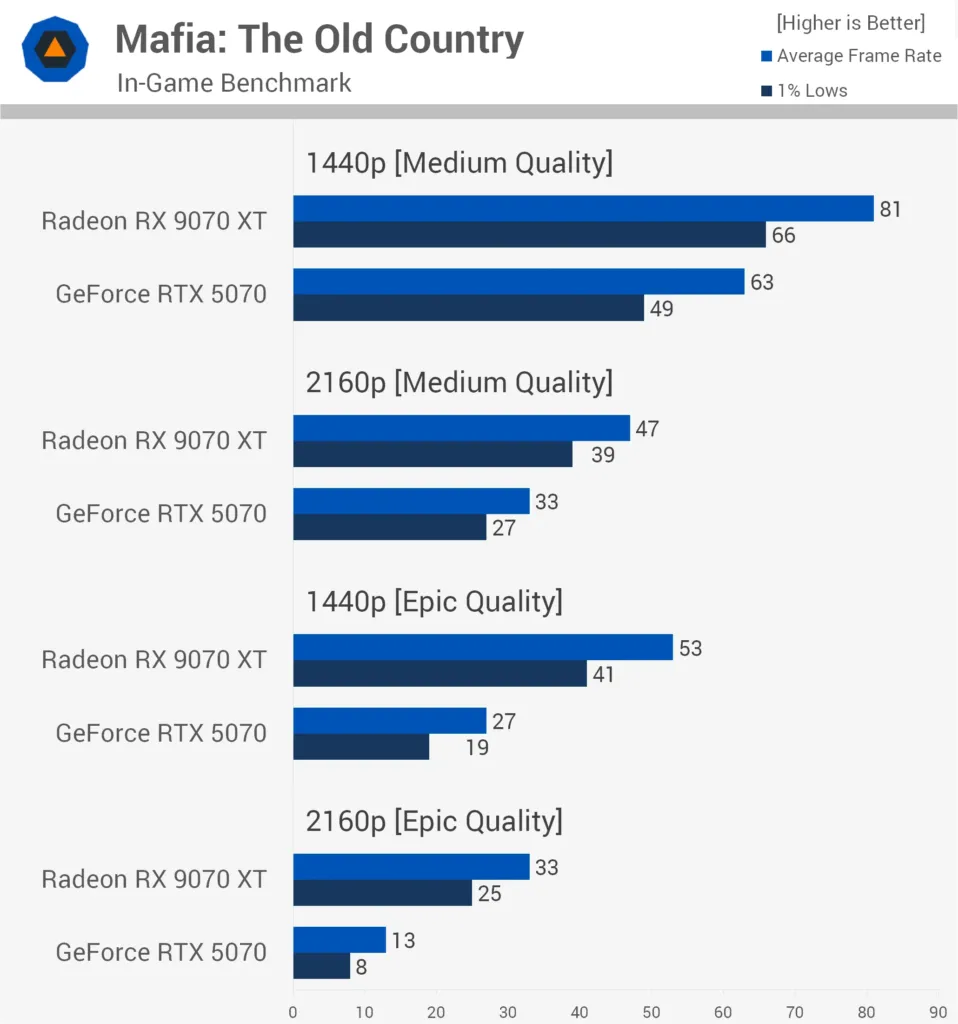
- 2The RTX 5070’s 12GB of VRAM already runs into trouble in current games. Mafia: The Old Country at Epic quality pushes it to its ceiling, and the RX 9070 XT’s 16GB nearly doubles the headroom at 1440p.
- 3If your work is Blender, Redshift, V-Ray or Cinebench rendering, buy the RTX 5070. Puget Systems didn’t give the RX 9070 XT a single win across four render engines, and it also hit driver instability bad enough to force driver downgrades.
- 4Cyberpunk 2077 and Alan Wake 2 at full ray tracing still belong to the RTX 5070, most dramatically at 4K RT Ultra in Cyberpunk, where the RX 9070 XT posts a 9 fps result the RTX 5070 beats by 190 percent.
RTX 5070 vs RX 9070 XT: Specifications
Before anyone loads a game, the spec sheets already tell most of the story, and they don’t agree with each other. Newegg, TechSpot, and Puget Systems all list the RTX 5070 at 12GB of GDDR7 on a 192-bit bus, while Sanj lists it at 16GB. That’s not a rounding difference; it’s a different card on paper. The RX 9070 XT has no such dispute: 16GB of GDDR6 on a 256-bit bus, full stop, wider than the RTX 5070 regardless of which VRAM figure you believe. Bandwidth carries its own split. Newegg puts the RTX 5070 at 896 GB/s and the RX 9070 XT at 717 GB/s; Sanj puts them at 672 GB/s and 512 GB/s. Whichever source you trust, the RTX 5070 comes out ahead on bandwidth in both readings, even though it’s working with the narrower bus. Architecture and core count split the same way. Newegg calls the RX 9070 XT RDNA 4 with the RTX 5070 at 8,960 CUDA cores; Sanj calls the AMD card RDNA 3.5 and drops the Nvidia core count to 7,680, matching AMD’s 7,680 stream processors exactly. Process node is the one place the numbers hold steady: Sanj has the RTX 5070 built on 4nm against the RX 9070 XT’s 5nm.
| Specification | RTX 5070 | RX 9070 XT |
|---|---|---|
| Architecture | Blackwell | RDNA 4 (Newegg) / RDNA 3.5 (Sanj) |
| Core Count | 8,960 CUDA cores (Newegg) / 7,680 (Sanj) | 7,680 stream processors |
| Memory Type | GDDR7 | GDDR6 |
| VRAM | 12GB (Newegg, TechSpot, Puget Systems) / 16GB (Sanj) | 16GB |
| Memory Bus | 192-bit | 256-bit |
| Memory Bandwidth | 896 GB/s (Newegg) / 672 GB/s (Sanj) | 717 GB/s (Newegg) / 512 GB/s (Sanj) |
| Process Node | 4nm (Sanj) | 5nm (Sanj) |
Measured 1440p Frame Rates
Newegg’s own chart has the RX 9070 XT ahead of the RTX 5070 by 7 to 17 percent in raster, and neither card struggles to clear 144 fps at 1440p in the fast, competitive games where that number actually matters.
TechSpot ran the widest set of any outlet here, 52 games, and came back with a bigger gap than Newegg found: the RX 9070 XT finished 24 percent faster at 1440p and 25 percent faster at 4K. That’s a consistent lead across two resolutions from the largest sample size in this comparison, not a fluke tied to one setting.
sanj.dev tested a smaller pool and landed on the opposite winner: the RTX 5070 ahead by 12 to 15 percent at 1440p overall, and 117 FPS to 98 FPS in Cyberpunk 2077 specifically. Put that next to TechSpot’s 24 percent RX 9070 XT lead and you’ve got two credible outlets disagreeing on which card wins the resolution outright, which is exactly why the game list a reviewer picks matters as much as the hardware they’re testing.
Cyberpunk 2077 1440p FPS, sanj.dev
- 007 First Light: RX 9070 XT leads 36 to 46 percent
- Pragmata: RX 9070 XT leads 31 to 40 percent
- Starfield: RX 9070 XT leads 28 to 44 percent
- Cyberpunk 2077 raster: RX 9070 XT leads 43 to 50 percent
- Battlefield 6: RX 9070 XT leads 18 to 42 percent
Memory Capacity in Real Games
Specs are one thing; running out of memory mid-game is another, and two 2026 titles show exactly where that happens. Newegg’s own testing says the RTX 5070’s 12GB is enough for 1440p gaming right now, and for most of the library that’s true. But the RX 9070 XT’s extra 4GB isn’t sitting there for show. It’s the difference that shows up first in texture-heavy games, and it’s the buffer that gives the 9070 XT room to grow as the next wave of games asks for more than 12GB holds.

- Mafia: The Old Country at Epic quality pushes the RTX 5070 straight into its 12GB ceiling; the RX 9070 XT nearly doubles it at 1440p and more than doubles it at 4K, and that gap isn’t a raw horsepower story, it’s a memory story.
- Star Wars Outlaws with RTX Direct Lighting set to Ultra at 4K is the other one: the 12GB buffer gets strained and the RTX 5070 hits what reviewers are calling severe memory limitations, the kind that shows up as stutter no matter how strong the GPU core underneath is.
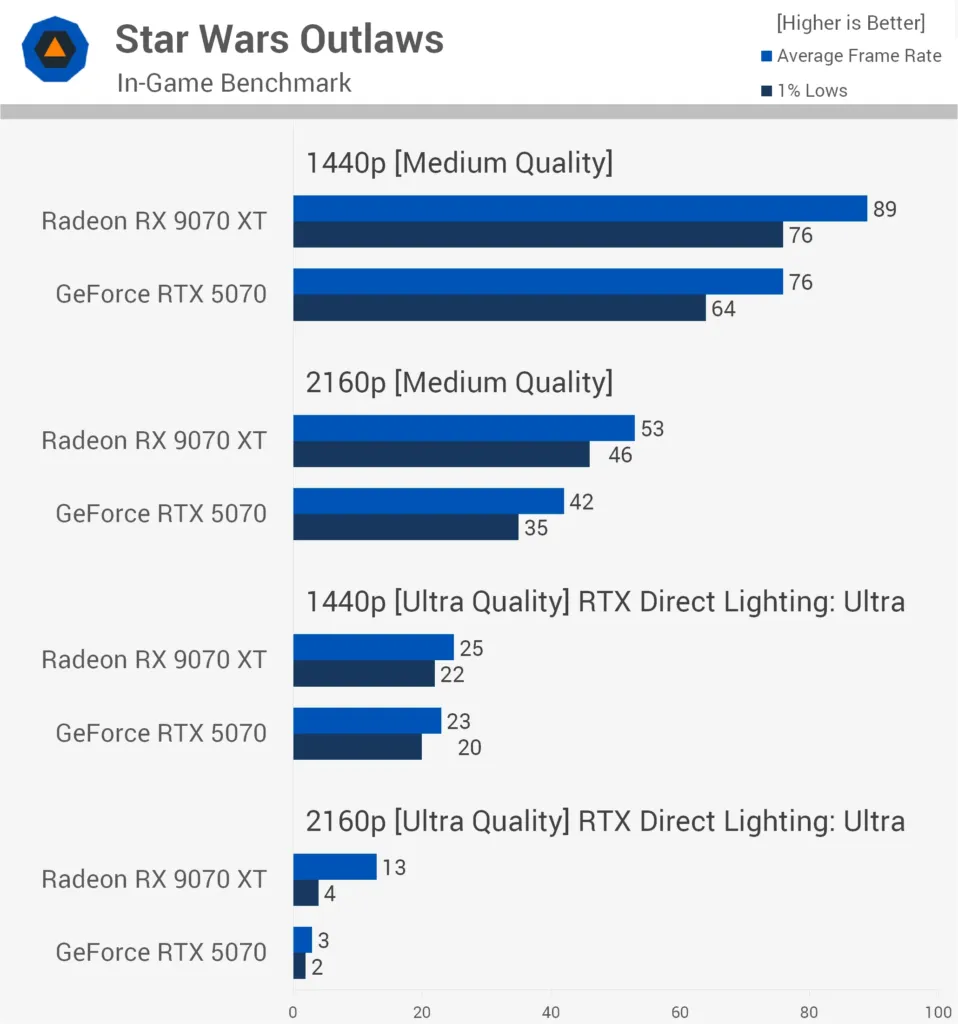
TechSpot’s Verdict
TechSpot calls the RTX 5070’s 12GB buffer somewhat questionable, and it’s a harder sell for one specific reason: this is the card asking for a price premium over the RX 9070 XT, not the one offering a discount for it. Paying more for less memory, in the games where that memory runs out, is what TechSpot says is difficult to recommend.
Ray Tracing: A Split Decision
Turn on ray tracing and the winner flips depending on which game you load. The RTX 5070 takes Alan Wake 2 and Cyberpunk 2077 when both run full ray tracing, the two games built around the technology from the ground up. Step outside those two, though, and TechSpot’s broader test suite has the RX 9070 XT ahead in many of the ray-traced titles it ran, the same card that already leads in raster.

Cyberpunk 2077 Ray Tracing FPS (Sanj.dev)
Doom: The Dark Ages 1440p Path Tracing FPS (TechSpot)
Push either card into the heaviest ray tracing settings and the results swing hard in both directions. At 4K with Cyberpunk 2077’s RT Ultra preset, the RTX 5070 collapses to 9 fps, and the RX 9070 XT ends up 190 percent faster at that same setting. Flip to Doom: The Dark Ages with full path tracing at 1440p and the RTX 5070 comes out ahead, 25 fps against 19 fps for the RX 9070 XT. Indiana Jones and the Great Circle with full ray tracing enabled goes the RTX 5070’s way too, by 10 to 19 percent depending on the scene. There’s no single answer here, the game decides which architecture wins.
DLSS 4 vs FSR 4
Nvidia’s DLSS 4 brings Multi Frame Generation to the RTX 5070, a feature AMD has no direct answer for, and it’s a real advantage in the games that support it. FSR 4 has closed ground on image quality but still trails DLSS 4 when you’re looking closely at the upscaled frame, AMD’s tradeoff is that FSR 4 runs across a wider range of hardware than Nvidia’s stack does.
Does DLSS Close the Gap?
TechSpot’s take is blunt: DLSS 4’s feature set doesn’t make up for what the RTX 5070 costs, especially when the RX 9070 XT wins raster and often wins ray tracing too. A software feature is worth something, but it isn’t worth a card losing on price and losing on performance in the same breath.
Multi Frame Generation is the headline feature Nvidia is selling the RTX 5070 on, and not every gamer watching the marketing around it is buying the pitch. One YouTube comment sums up the skepticism:
But have you seen the DLSS 8 with 67 X frame gen?????
Rated Power Draw
Plug in either card and the wattage you should expect depends entirely on whose sheet you’re reading. Newegg puts the RTX 5070 at 250W total board power and the RX 9070 XT at 304W, a real gap that matters when you’re sizing a PSU. Sanj’s numbers erase that gap entirely, listing both cards at 220W. Two sources, two different stories about how hard these cards actually pull, and Newegg’s figures are the ones you’ll see cited most often when people talk board power for this generation.
| Source | RTX 5070 | RX 9070 XT |
|---|---|---|
| Newegg | 250W | 304W |
| Sanj | 220W | 220W |
Power Supply Recommendations
A quality 750W 80 Plus Gold power supply covers either card without drama. That changes once you pair it with a high-TDP processor like the Ryzen 9 9950X3D, at which point you’ll want to step up to 850W so the rest of the system isn’t fighting the GPU for headroom. Both cards use standard ATX 3.1 power connectors, so there’s no cabling penalty either way. Where the RTX 5070’s lower rated draw actually earns its keep is in a build where PSU headroom is already tight and you can’t afford to size up.
Thermals and Noise Under Load
Under sustained load, the RX 9070 XT runs 3 to 5 degrees Celsius cooler than the RTX 5070, and that thermal edge shows up in the noise levels too: 36 dBA for the RX 9070 XT against 38 dBA for the RTX 5070.
Professional Rendering: Blender, Redshift, V-Ray, Cinebench
Puget Systems put both cards through four render engines, and the RTX 5070 didn’t lose a single round. Not one benchmark, not one workload.
| Benchmark | RTX 5070 | RX 9070 XT |
|---|---|---|
| V-Ray (seconds) | 247 | 278 |
| Redshift (seconds) | 104 | 192 |
| Blender Benchmark (score) | 5,968 | 3,722 |
| Blender Junkshop (seconds) | 37.5 | 52.4 |
| Blender Classroom (seconds) | 185 | 303 |
| Cinebench 2026 GPU (score) | 75,629 | 52,327 |
The margins aren’t close, either. V-Ray is the tightest of the bunch at 247 seconds against 278, but Redshift nearly doubles the gap: 104 seconds on the RTX 5070 versus 192 on the RX 9070 XT. Blender’s own benchmark scores it at 5,968 against 3,722, and the Blender Classroom scene takes 185 seconds on the RTX 5070 against 303 on the RX 9070 XT. Cinebench 2026’s GPU test puts 75,629 up against 52,327. However you slice it, this is a different category of performance, not a rounding error.
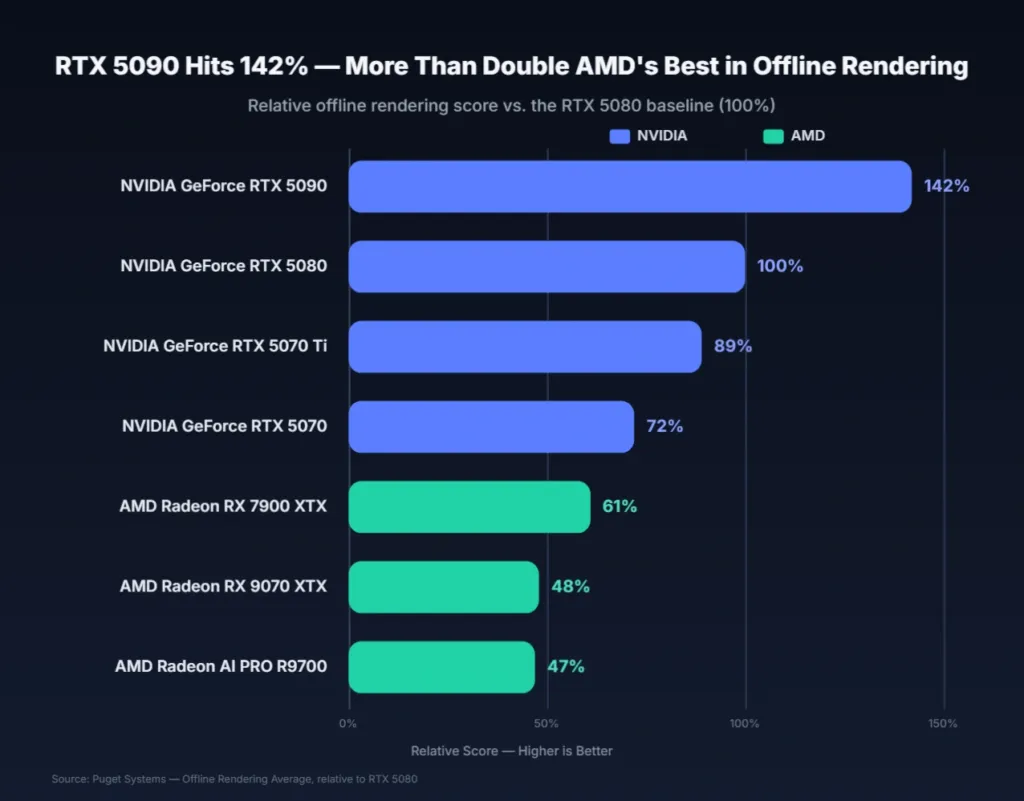
Stretch those per-frame numbers out to an actual animation and the gap stops being an abstraction. A one-minute clip at 1,440 frames takes 53 hours to render on an RTX 5090. On the RX 9070 XT, the same clip needs 111 hours. That’s the difference between finishing over a weekend and finishing sometime the following week.
It’s the same story outside the dedicated render engines. In Premiere Pro, the RTX 5070 chews through a timeline 25 percent faster than its own predecessor, the RTX 4070, and 30 percent faster than the RX 9070 XT sitting next to it. The Blender BMW scene finishes in 17.8 seconds on the RTX 5070 against 29.4 seconds on the RX 9070 XT, and on AI workloads the RTX 5070 runs at roughly double the speed of the RTX 4070. For anyone whose job touches video editing or AI-assisted tools alongside gaming, this isn’t a close call.
AMD’s Rendering Reliability Problems
Speed wasn’t the only issue Puget Systems ran into with AMD hardware. V-Ray Standalone kept crashing on the AMD GPUs, forcing Puget to complete that testing through 3ds Max instead. The RX 9070 XT also hit driver instability bad enough that testers had to downgrade drivers to keep going, and AMD’s cards sometimes reported VRAM exhaustion after a render finished that wasn’t actually happening. If rendering is part of your workflow rather than an occasional task, these aren’t footnotes.
For anyone doing serious rendering work, NVIDIA stays the clear pick, and it isn’t close once you factor in the driver crashes on top of the raw speed gap. AMD still makes sense if rendering is something you do occasionally rather than for a living, or if the budget won’t stretch to NVIDIA’s asking price.
What These Cards Actually Cost
What these two cards were supposed to cost and what they actually go for are two different conversations, and even the first one can’t agree with itself. Sanj has the RTX 5070 launching at $699, Puget Systems has it at $549, a $150 gap on the exact same card. Both sources at least agree on the RX 9070 XT: $599 at launch. When the retailers testing these cards can’t settle on what one of them was supposed to cost, the official number has already stopped being useful.
Street prices don’t settle the question either, they just move it around. On Newegg the RTX 5070 starts at $609.99 against $699.99 for the RX 9070 XT, a roughly $90 win for the GeForce card. TechSpot found the opposite world entirely: the RX 9070 XT at $730 to $750, RTX 5070 cards starting at $800 with most sitting around $820. Puget Systems’ June 2026 retail check swung back toward Newegg’s version, with the 5070 near $599 and the 9070 XT near $669. Three outlets, three different answers to ‘which one’s cheaper,’ and none of them wrong, just measured at a different place and time.
| Source | RTX 5070 | RX 9070 XT |
|---|---|---|
| MSRP (Sanj) | $699 | $599 |
| MSRP (Puget Systems) | $549 | $599 |
| Newegg starting price | $609.99 | $699.99 |
| TechSpot street price | from $800, most ~$820 | $730 to $750 |
| Retail June 2026 (Puget Systems) | ~$599 | ~$669 |
Cost Per Frame at 1440p and 4K
Divide price by frames and TechSpot’s US numbers make the RTX 5070 a 37% premium per frame at 1440p and a 39% premium at 4K, which is what happens when a slower card also costs more. The cleaner test is Australia, where TechSpot noted both cards land at roughly the same price. Strip the price gap out entirely and the Radeon still comes out about 25% ahead on cost per frame. That’s the number that separates the pricing argument from the performance one: even at parity, the RX 9070 XT is doing more with the same money.
RTX 5070 cost-per-frame premium over RX 9070 XT
The Rest of the GeForce Stack
Zoom out and the RTX 5070’s pricing mess looks less like a one-off and more like the whole lineup moving. TechSpot found the RTX 5070 Ti over $1,100 and the RTX 5080 around $1,500, and the damage isn’t just at the top: the RTX 5060 Ti 16GB, a card two tiers below the 5070, went from around $580 to roughly $800, a rise of almost 40% in a matter of weeks. When the card below climbs to where the card above used to sit, the ladder itself has stopped meaning anything, and that’s the backdrop every price in this comparison is sitting against.
PCWorld put the plainest version of it on the page: a whole Xbox Series X or PS5 costs under $500, and PC gamers are being asked to pay over $1,000 for the graphics card alone. Nothing about that ratio needs a benchmark to make its point.
None of this is landing quietly with the people actually trying to buy one of these cards.
Those prices are bloody criminal.
The worst timing belongs to anyone who’s already mid-build, watching the budget they set months ago move underneath them before the last part even ships.
Why is it that everytime i decide to build a pc the market gets OBLITERATED 😭😭💔
Check current prices before deciding
Newegg, TechSpot and Puget Systems each measured a different price for both of these cards, and which one comes out cheaper flips depending on which of the three you’re looking at. Check live pricing before you buy. Any verdict built on a single price snapshot is out of date the moment the next one lands.
Two Verdicts: TechSpot and Newegg Disagree
TechSpot can’t picture handing the RTX 5070 the win, not even in the one scenario built for it: matching prices. At the same dollar, TechSpot says the 9070 XT is still the stronger card, and it comes with 16GB of VRAM against the 5070’s 12GB. TechSpot calls that 12GB buffer long questionable, a line that reads less like a nitpick and more like a warning about where this card sits in two years.
Zoom out from these two cards and TechSpot’s complaint gets bigger: GeForce pricing across the board has gotten badly distorted, and the RX 9070 and RX 9060 series are named as among the few sensible options left in this bracket. TechSpot’s advice is blunt – buy into RDNA 4 while the pricing still makes sense, because there’s no guarantee it stays that way.
Newegg reads the same market and lands somewhere else entirely. Its own writeup gives the RTX 5070 the edge for most gamers in 2026, pointing to a broader feature set and a lower starting price. On Newegg’s own shelves, that’s $609.99 for the RTX 5070 against $699.99 for the RX 9070 XT – a comparison worth remembering rests on Newegg’s pricing, not the pricing TechSpot tested against.
Rendering is the one category where nobody’s arguing. Puget Systems still recommends NVIDIA clearly for creative work, citing better performance, tighter optimization, and fewer stability issues across the board. Puget also hit driver instability on the RX 9070 XT during its own testing, which is the kind of thing that matters more to somebody billing hours than somebody chasing frame rates.
Owners on the ground land on roughly the same split the labs found. One buyer weighing both cards for gaming and creative work put it this way:
The 9070XT is much better in most places. One of the only places the 5070 is better is in Blender rendering and Adobe applications though.
Not every GeForce owner crosses over easily, either. Some hesitate before trading years of NVIDIA drivers for a Radeon card, and the reaction after the fact tends to run in one direction:
I was a bit hesitant switching from Team Green to the Red Train but now I’m ready to ride this bitch to the wheels fall off.
PCWorld takes the whole comparison somewhere neither TechSpot nor Newegg goes: skip this generation entirely. Its read on the RX 9070 XT is that it’s good enough, which PCWorld treats as the actual complaint rather than the compliment – prices climbed after release, and PCWorld notes you’re now looking at $1,000 GPUs stacked against consoles that sell for under $500. That’s not a knock on the 9070 XT specifically; it’s a question about whether this whole price bracket is worth playing in right now.
9070 XT average lead over RTX 5070 across 52 games
RTX 5070 cost-per-frame premium over 9070 XT
- Buy the RX 9070 XT if you game mostly in rasterized titles at 1440p – it’s the faster card there.
- Buy the RX 9070 XT if you want VRAM headroom for the next few years – 16GB against the RTX 5070’s 12GB.
- Buy the RTX 5070 if you play heavy ray-traced or path-traced titles like Cyberpunk 2077 or Alan Wake 2.
- Buy the RTX 5070 if DLSS 4 Multi Frame Generation matters to how you play.
- Buy the RTX 5070 if you render in Blender, Redshift or V-Ray – NVIDIA wins every round there.
- Factor in power draw before you decide: the RTX 5070 pulls 250W against 304W for the RX 9070 XT.